Commercial roof storm damage in Wichita falls into six groups: fractured or punctured membranes, crushed insulation, lifted seams, loose edge metal, dented rooftop units and clogged drains. Hail usually damages the membrane and equipment, while wind attacks edges, corners and flashing first. Inspect from the ground, photograph everything, and call the insurer before any permanent repair.
This guide covers inspection of low-slope roofs and metal buildings, the June 13, 2026 winds around Wichita, and how to document a claim for commercial roof storm damage that insurers will review.
What does commercial roof storm damage usually look like?
Most commercial roof storm damage is hard to see from the parking lot. Roofing Contractor magazine notes that all commercial low-slope membranes can be damaged by hail to some extent, and that single-ply membranes are the most vulnerable because they have no protective surfacing.
The common findings after hail and wind fall into a short list:
- Membrane fractures and punctures. Single-ply sheets often crack from the underside first.
- Crushed or wet insulation. Dents in the board can be functional damage.
- Lifted seams and backed-out fasteners. These point to wind uplift.
- Displaced coping and edge metal. This is the most common wind failure point.
- Dented rooftop units. Bent coil fins slow heat transfer.
- Clogged drains and scuppers. Windblown debris causes ponding later.
Hail size matters. An SGH engineering brief says single-ply membrane damage can begin with hail of 1.5 inches or larger. A 2 inch stone carries more than twenty times the impact energy of a 1 inch stone.
Can I climb on the roof to check it myself?
No. The NRCA says owners should “only perform a roof system inspection from ground level.” Its release on storm damage and roof repairs says the risk of falling is too great without the proper safety systems in place.
From the ground, look for debris on the roof, bent vents, displaced edge metal and fresh stains on ceiling tiles inside. NRCA also advises clearing windblown debris from drains and downspouts. Let a qualified contractor do the walk, such as a commercial roofing contractor in Wichita.
How do you check a flat roof for commercial roof storm damage from hail?
It depends on the membrane. Scott Morrison, P.E., writing in Professional Roofing in 2009, explained that “Base flashing usually is damaged by hail before other parts of a low-slope roof system.” He also described how to read each roof type.
| Roof type | Where hail damage shows | Check |
|---|---|---|
| Built-up (BUR) | Underside fractures, soft spots | Sweep gravel aside, look for fresh black bitumen |
| Modified bitumen | Ruptured reinforcement, star-shaped fractures | Feel for soft spots, check granule loss |
| TPO, PVC, EPDM | Crescent fractures, stress plates at laps and fasteners | Use good lighting, dry the surface first |
| Spray foam (SPF) | Thin, low-density areas | Inspect closely by touch |
| Metal panels | Ruptured panels, open laps, coating damage | Check laps and field-applied paint |
Morrison adds that water, snow or ice can hide fractures. Roofing Contractor says roofs should be inspected after every hailstorm.
Moisture is the next question. A guest article on the Merlin Law Group blog about low-slope roof damage states, “Wet roofing materials and insulation is functional damage.” It recommends a nondestructive moisture survey, such as infrared thermography, by a certified firm. For repair choices after the survey, see storm damage roof repair in Wichita.
What does wind do to edges, coping and rooftop units?
It pulls hardest at the perimeter. An FM Global brochure, Protecting Roofing Systems Against Windstorm Damage, says uplift at a corner can exceed uplift in the field by more than 2.5 times. It calls metal-edge perimeter flashing the roof’s most important component, because a loose edge makes further damage likely.
Edge systems are tested under ANSI/SPRI ES-1, the Wind Design Standard for Edge Systems Used with Low-Slope Roofing Systems. A Carlisle SynTec article reports that Factory Mutual attributes 80% or more of roof failures to roof edge failure.
After a storm, look for gaps in coping joints, edge metal that sits away from the wall and membrane peeling at the termination. Backed-out fasteners can create tent-like conditions, so stay off those areas.
Units take hail too. AmTrust guidance on roof-mounted HVAC and hail says coil fins can compress, which slows heat transfer, and that damage from repeated storms is cumulative.
How do metal buildings and warehouses fail in storms?
At trim, perimeters and fasteners. MBCI, a metal panel manufacturer, says trim that is not properly fastened or sealed is typically where water infiltration begins after a storm. Check ridge caps, gable trim, panel laps and sealing washers.
Dents are a separate question. MBCI states that “A dent does not automatically mean a failed system.” What matters is whether the coating, substrate or weathertightness of the panel was compromised. Cracked paint at a dent is where corrosion can start.
What did the June 13, 2026 storm do around Wichita?
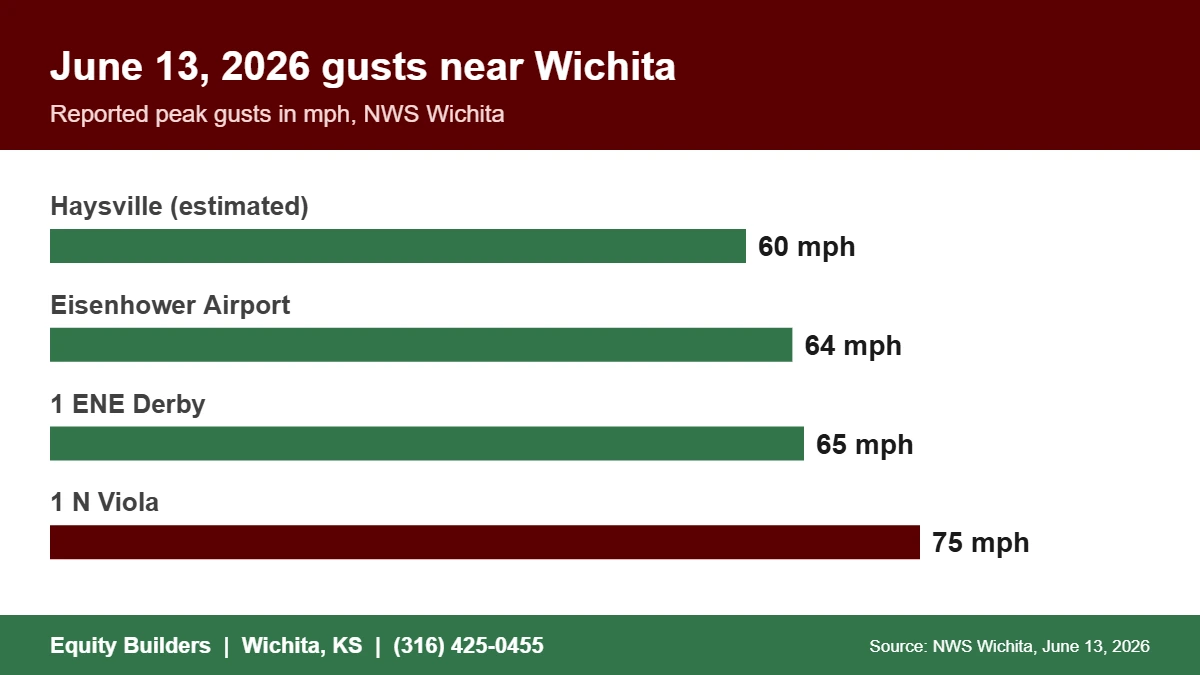
The National Weather Service Wichita event summary lists a measured 64 mph gust at Eisenhower National Airport at 8:48 pm, a 65 mph gust 1 ENE of Derby, an estimated 60 mph gust at Haysville and a measured 75 mph gust 1 N of Viola. Hail reached 4.00 inches 4 N of Winfield.
These reports give a date, a time and a measured speed near your building. Save them with your photos. See also wind damage to roofs in Wichita.
How do you document commercial roof storm damage for an insurer?
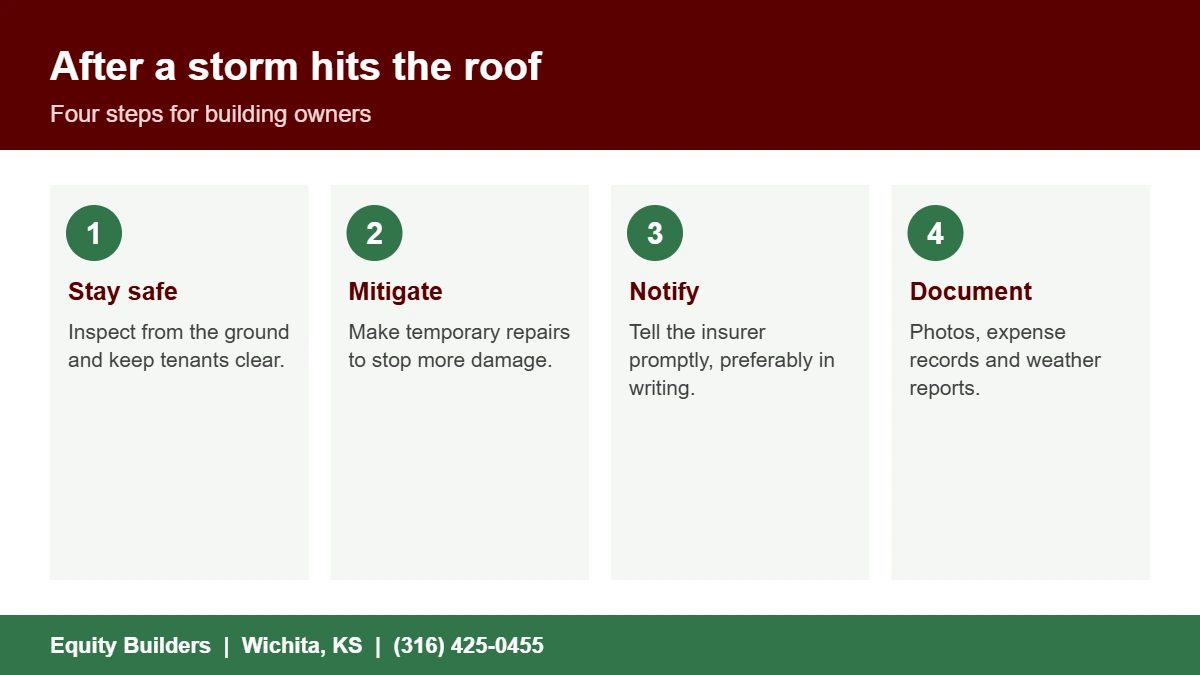
Follow this order for commercial roof storm damage claims in Wichita:
- Make it safe. Keep tenants away from ceilings that sag or stain.
- Mitigate. A Hylant commercial loss checklist lists temporary repairs to prevent further damage.
- Notify. Hylant says to notify the insurer promptly, preferably in writing.
- Document. Photograph roof, equipment and interior leaks, and keep every expense record.
- Proof of loss. Prepare a document detailing the damaged property and the amount, and submit it.
Our checklist of roofing claim documentation and the broader roof insurance claims guide cover the details. Read your policy for notice deadlines, suit limits and any cosmetic damage exclusion. This is general information, not legal advice.
Kansas claim handling rules apply too. K.A.R. 40-1-34 applies to all policies except workers’ compensation. It requires an insurer to acknowledge a claim within ten working days and complete its investigation within thirty days unless it cannot reasonably do so.
Can a public adjuster handle a commercial roof claim in Kansas?
Yes, if licensed. The Kansas Insurance Department says a public adjuster may work only when the claim is associated with a commercial lines policy, and applicants must pass the Kansas Public Adjusters Examination. Kansas Attorney General Opinion 2025-22 confirms the Public Adjusters Licensing Act covers only commercial lines.
Check the license with the department before signing. Any roofer you hire should be registered too. See Kansas roofing contractor registration and roofing contractor scams.
Does a commercial roof repair need a permit?
Often it does. MABCD, the building department for Wichita and unincorporated Sedgwick County, charges roofing fees of $0.05 per square foot with a $50 minimum and a $1,500 maximum. Its Form 62 has a Commercial box and a field for the contractor’s Kansas roofer registration number. The code exempts roofing repair or replacement not exceeding 400 square feet in 12 months.
MABCD says commercial projects begin with a plan review, but its page does not say whether a reroof triggers one. Call 316-660-1840 first. See the Wichita roof permit guide.
Commercial roof storm damage questions from Wichita building owners
Can hail damage a flat roof without leaks?
Yes. Fractures and crushed insulation can exist before water shows up inside. Roofing Contractor says hail damage is often not visible on the surface. A moisture survey with infrared or similar methods can find trapped water, so dents on metal edges or units are reason enough to inspect.
How big must hail be to damage a commercial roof?
Single-ply membranes can be damaged starting near 1.5 inches, per SGH. An FM Global scientist told FM Approvals that most roofing systems without a Very Severe Hail rating start to fail at that size. Older, weathered membranes can fail sooner.
Get a commercial roof inspection in Wichita
Equity Builders is a Wichita general contractor, founded in 1985, with residential and commercial roofing, a lifetime workmanship warranty and no payment until the job is done. For commercial roof storm damage, Wichita building owners can call (316) 425-0455, read about hail damage roof repair, or request a free estimate.
Sources
- National Weather Service Wichita, event summary for June 13, 2026
- NRCA, press release on storm damage and roof repairs
- Roofing Contractor magazine, March 3, 2005; Professional Roofing, June 2009
- Merlin Law Group blog; FM Global brochure P0283 (2015); FM Approvals, hail article
- Carlisle SynTec, ES-1 article, May 2020; SGH hail brief; MBCI; AmTrust; Hylant
- Kansas Insurance Department; Kansas AG Opinion 2025-22; K.A.R. 40-1-34
- Sedgwick County MABCD permits and fees and Form 62
Last updated October 24, 2026. Codes, fees and policy terms change, so confirm with MABCD and your insurer before work begins.