Kansas roofing contractor registration is required by state law for anyone who installs, repairs or replaces roofs for pay. Since July 1, 2013 every roofing contractor has had to hold a registration certificate from the Kansas Attorney General. You can check any roofer in about two minutes, for free, before you sign a contract.
This guide shows Wichita homeowners how to run the lookup, what each status means, and what else to verify with the local building department.
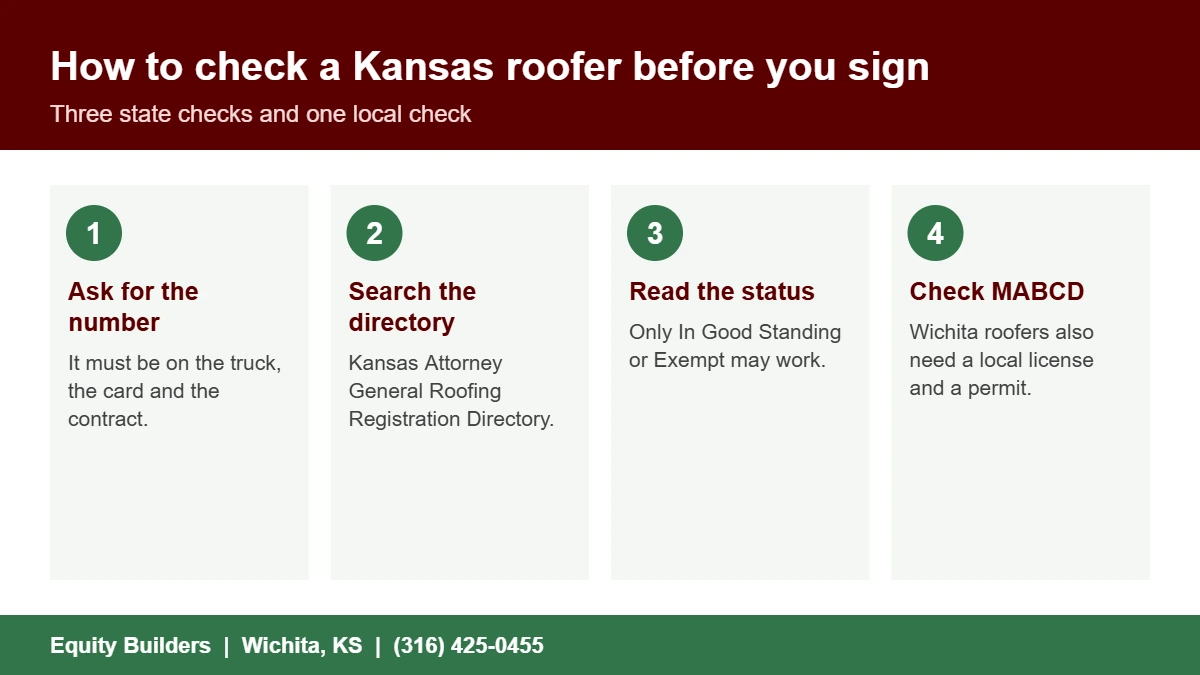
How do I check a Kansas roofing contractor registration?
- Ask for the certificate number. State law requires a roofer to display the number “on each commercial vehicle used for roofing services and upon every business sign, card, correspondence and contract” (K.S.A. 50-6,135). If it is not on the truck or the estimate, ask why.
- Search the Roofing Registration Directory. The Attorney General’s directory lets you enter a business name, contact name or city. Each listing shows the business name, status, registration number, contact name, city and state.
- Read the status. Only two statuses allow a company to work. The table below lists all six.
If you cannot find a company, call the Attorney General’s office at (785) 368-6644.
What do the registration statuses mean?
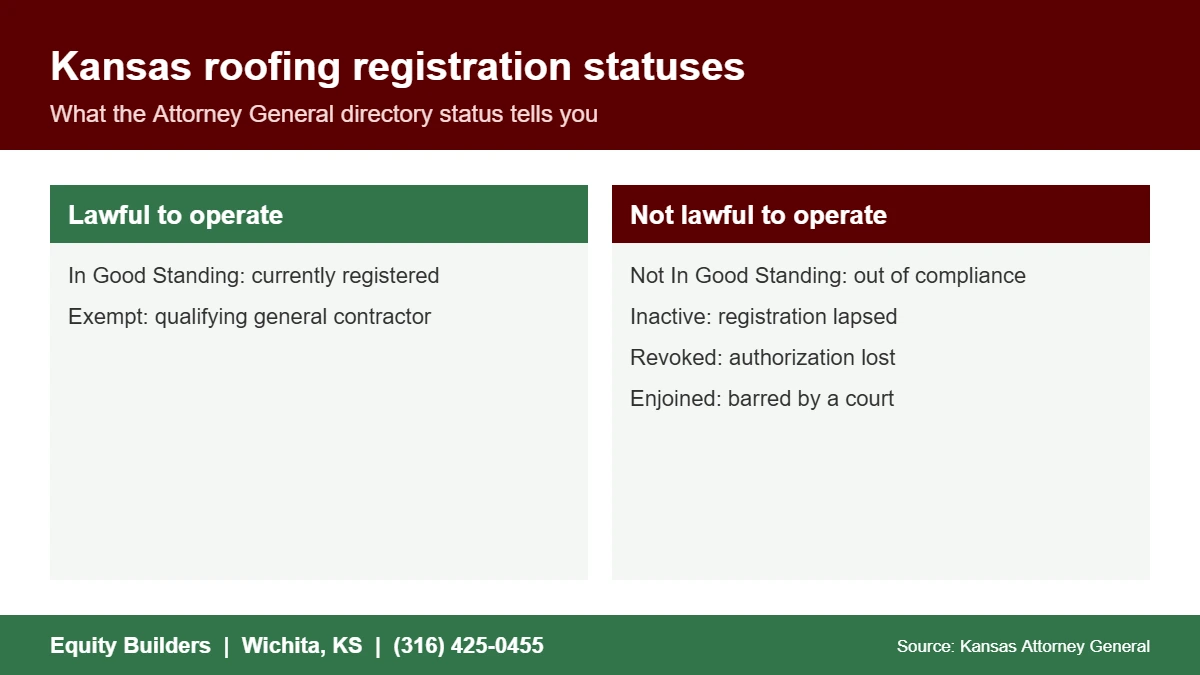
| Status | Meaning | May the roofer work? |
|---|---|---|
| In Good Standing | Currently registered | Yes |
| Exempt | General contractor that qualifies for the exemption in K.S.A. 50-6,122 | Yes |
| Not In Good Standing | Currently out of compliance | No |
| Inactive | Registration lapsed | No |
| Revoked | Failed to comply and lost authorization | No |
| Enjoined | Barred by a court from providing services | No |
The Attorney General adds a caution to the directory: “Registration does not constitute an endorsement of a listed contractor.” A certificate proves the paperwork is in order. It says nothing about workmanship.
What does a roofer have to prove to get registered?
Under K.S.A. 50-6,125 an applicant must be at least 18 and file:
- A certificate of liability insurance of “not less than $500,000.”
- Proof of workers’ compensation coverage, or an affidavit of exemption.
- A current tax clearance certificate from the Kansas Department of Revenue.
The annual fee is set by the Attorney General and may not exceed $500. Certificates expire each June 30. A roofer who has not renewed by July 31 is revoked under K.S.A. 50-6,132, which is why a company can be legal in June and unlawful in August. Check the status again if a job is scheduled across the summer.
Can a roofer work under someone else’s Kansas roofing contractor registration?
No. K.S.A. 50-6,127 says a certificate “cannot be shared or used by any other individual or business entity.” The number must be valid “at the time of soliciting a project and during subsequent job performance.” If the name on the contract does not match the name in the directory, stop and ask who will hold the permit and carry the insurance on your job.
Who is exempt from Kansas roofing contractor registration?
K.S.A. 50-6,129 lists the exemptions. The ones homeowners meet most often are:
- Owners who physically do roofing work on their own property.
- Jobs under $2,000 per project, unless the person advertises as a roofing contractor.
- Exempt general contractors. The definition covers a general contractor whose roofing work is no more than 50 percent of the total project cost and who does not sell door to door, or one who hires registered roofing contractors for the roof.
A company that knocks on doors after a hailstorm and sells only roofs does not fit the general contractor exemption.
What happens if I hire an unregistered roofer?
The legal risk sits mostly with the roofer, and the practical risk sits with you.
- Anyone who acts as a roofing contractor without a valid certificate is liable for a civil penalty under the Kansas Consumer Protection Act of up to $10,000 per violation (K.S.A. 50-6,123 and 50-636).
- An unregistered roofer may not “bring or maintain any claim, action, suit, or proceeding in any court of this state” related to the roofing business.
- An insurance assignment signed with a contractor who fails to comply with the registration act is void under K.S.A. 50-6,143.
- No registration usually means no verified liability insurance and no workers’ compensation on your property.
- The roofer cannot lawfully pull the permit, which leads to the next check.
What else should Wichita homeowners verify?
Kansas roofing contractor registration is one of two credentials here. In Wichita and unincorporated Sedgwick County, roofing companies must also be licensed by the Metropolitan Area Building and Construction Department (MABCD), and roofing work requires a permit and inspection. The Sedgwick County District Attorney repeated both points in a September 4, 2025 consumer alert.
The two systems connect. A roofer must give the state registration number to the permit office, and the official writes it on the permit. MABCD’s roofing permit application has a line for the “KS Roofer Registration Number.” Our guide to the roof replacement permit in Wichita explains fees and inspections.
MABCD is at 271 W. 3rd St. N., Suite 101, in downtown Wichita. The phone number is 316-660-1840.
Why does this matter after a storm?
Because storms bring crews from out of state. After hail hit Saline, Kingman, Nemaha and Barber counties and a tornado struck Sumner County in March 2026, Attorney General Kris Kobach issued this reminder: “When considering roofing work on a home or business, it is important that consumers make sure their roofing contractor is properly registered before signing any contract or having any work done.”
His office also recommends getting three written estimates, checking Better Business Bureau complaint records and asking about cancellation rights. In May 2026 the Kansas Insurance Department pointed homeowners to the same directory during Contractor Fraud Awareness Week.
Sedgwick County sees the same pattern. On June 13, 2026 the National Weather Service measured 65 mph near Derby and 60 mph in Haysville, and yard signs from unfamiliar companies appear within days of nights like that.
Kansas roofing contractor registration: common questions
Do roofing contractors have to be licensed in Kansas?
Kansas does not issue a statewide roofing license with an exam. It requires registration with the Attorney General. Cities and counties add their own licenses. In Wichita that is MABCD.
Does Kansas require general contractors to be licensed?
Not at the state level. Licensing for general contractors is handled locally. A general contractor who does roofing must either register as a roofing contractor or meet the exemption in the roofing act.
How can I report an unregistered roofer?
The Attorney General’s roofing page has a form to report an unregistered roofer, or you can call (785) 368-6644. The Consumer Protection line is (800) 432-2310.
Is Equity Builders registered?
Yes. Equity Builders is registered with the Kansas Attorney General’s Consumer Protection Office, holds an A+ rating with the Better Business Bureau and has worked from 442 S. Ellis St. in Wichita since 1985. Search for us in the directory the same way you would search for anyone else. Our about page lists our credentials and customer reviews.
Next steps
Check the Kansas roofing contractor registration of every company that bids on your roof, then compare the bids. Our guides on how to choose a roofing contractor in Wichita, roofing scams to avoid and whether a roofer can pay your deductible cover the rest. To get a written bid from a registered local company, call (316) 425-0455 or request a free estimate.
Sources
- Kansas Attorney General, Roofing and Roofing Registration Directory
- Kansas Roofing Registration Act, K.S.A. 50-6,121 through 50-6,138, including 50-6,132 and 50-6,128
- Sedgwick County District Attorney, consumer alert, September 4, 2025
- MABCD Form 62, Roofing and Siding Permit Application
- WIBW, Kobach warns Kansans of unregistered contractors, March 6, 2026
- Kansas Insurance Department, Contractor Fraud Awareness Week release, May 20, 2026
- National Weather Service Wichita, June 13, 2026 event summary
Last updated October 7, 2026. General information only, not legal advice.