Roof replacement in winter is possible in Kansas, but it is slower and needs extra steps. GAF’s official recommendation is to install shingles at 40°F or above. Below that, manufacturers allow the work only with precautions such as hand-sealing each shingle, because cold shingles crack and their sealant strips do not bond. Wichita’s normal daily highs stay above 40°F all winter, so many days work.
This guide covers the manufacturer rules, the Wichita weather numbers, the safety limits, the trade-offs and when waiting is the wrong call.
Is roof replacement in winter possible in Kansas?
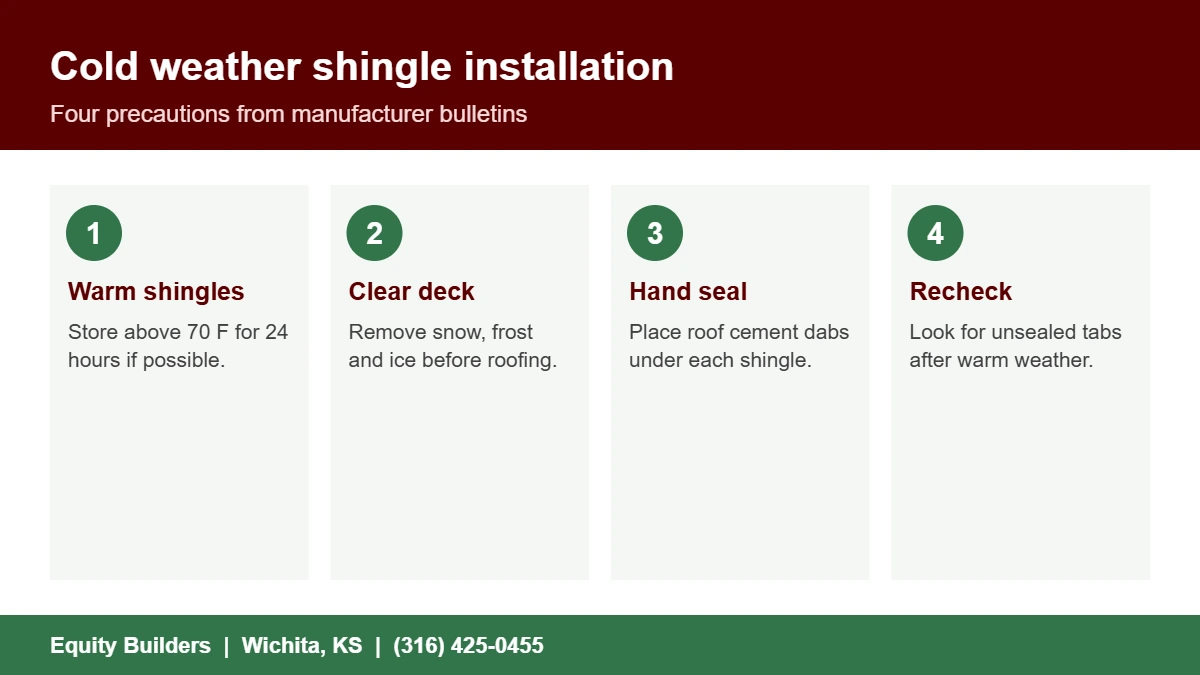
Yes. GAF says that “The official GAF recommendation is to install shingles at temperatures that are at least 40°F/4°C.” The same page says installation below 40°F can occur when contractors follow the mandatory precautions.
GAF’s technical bulletin R-133 goes further. It states that “There is no practical lower or upper temperature limit governing when asphalt fiberglass shingles may be applied” as long as precautions are taken. Equity Builders says it schedules installations for days above 40°F.
What do shingle manufacturers say about cold weather?
They agree on the 40°F line and the fix. Each source below treats cold as a handling and sealing problem, not a ban.
| Source | Cold-weather rule |
|---|---|
| GAF blog | Install at 40°F or above when possible. Store shingles at 70°F for 24 hours before installing. Clear snow, frost and ice off the deck. |
| Owens Corning bulletin | Rules apply when air and surface temperatures are at or below 40°F. Hand seal each shingle with ASTM D4586 roof cement. |
| Malarkey bulletin | Store materials in a heated facility. Never bend, throw or drop bundles. Hand-sealing is strongly recommended in adverse weather. |
| Atlas, in Roofing magazine (2019) | Most sealants do not thermally activate below 40°F. Nail by hand in low temperatures to avoid blow-through. |
Why does cold weather hurt shingles, and how do crews hand-seal?
Two reasons: brittleness and sealing. GAF warns that below 40°F asphalt shingles lose flexibility and may crack. Its R-133 bulletin adds that cold shingles can curl and fail to lie flat.
The second problem is the factory sealant strip. It needs warmth and sun to bond. Until it does, wind can lift tabs. The Owens Corning warranty, quoted in an engineering bulletin by Donan Engineering, says: “If your shingles are installed during a period of cool weather, they may not adequately seal until the season changes.”
The same bulletin cites ARMA guidance that the top six courses and all rake courses are especially prone to blow-off when unsealed. Our page on wind damage to Wichita roofs shows what that damage looks like.
The fix is dabs of asphalt roofing cement under each shingle. The method varies by product, so crews follow the label and the bulletins.
- Owens Corning, laminated shingles. Four 1-inch dabs of ASTM D4586 cement, about 1 inch from the leading edge. For 3-tab shingles it calls for two dabs under each tab.
- Malarkey. Four quarter-size dabs, evenly spaced. Hand-sealing is required on slopes steeper than 21:12.
- GAF. Quarter-sized dabs under each tab. It warns that too much cement can run down the face or cause blistering.
Owens Corning also warns that excess cement can blister shingles. More dabs are not better. Ask the crew which bulletin they follow, and see our asphalt shingles in Wichita page for product background.
How cold does a Wichita winter get?
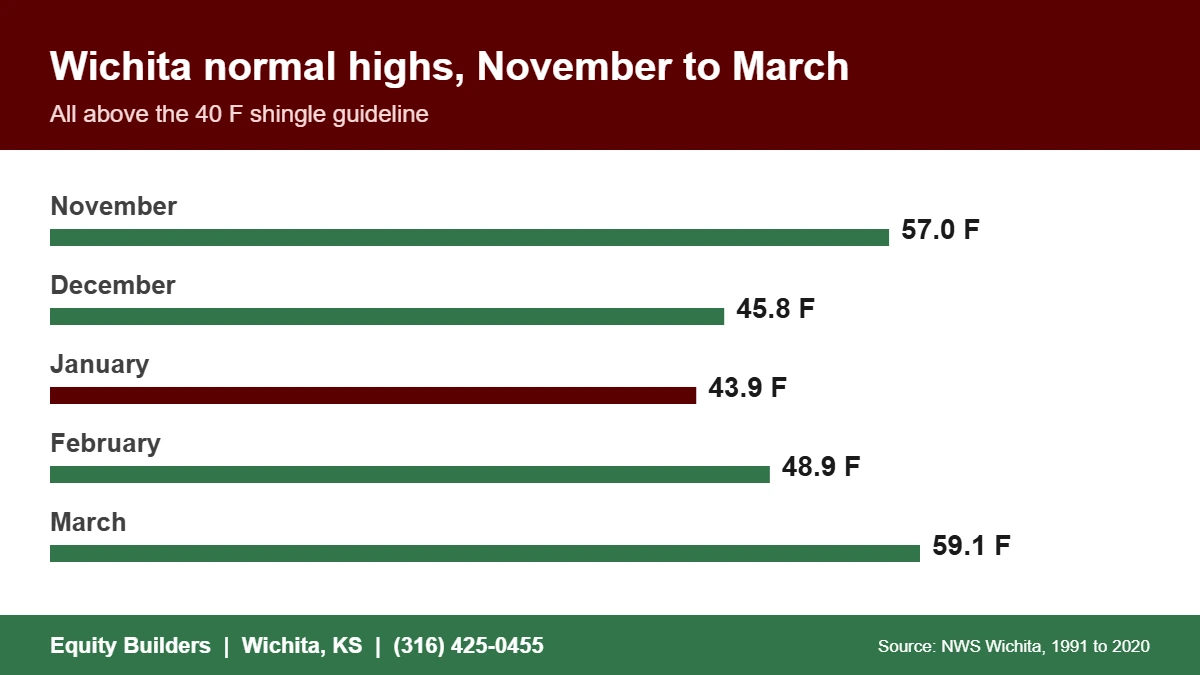
Not cold enough to stop work often, so roof replacement in winter fits many Wichita days. The National Weather Service 1991 to 2020 normals for Wichita give a December high of 45.8°F, a January high of 43.9°F and a February high of 48.9°F. Lows are the problem: 25.4°F in December, 22.5°F in January and 26.3°F in February.
That pattern shapes the schedule. Frost on the deck at dawn can push the start to late morning. Wichita also averages 12.7 inches of snow a year. GAF’s guidance calls for a deck clear of snow, frost and ice, so crews wait for it.
Is roof replacement in winter safe for the crew?
Safety is the other limit. An OSHA-hosted roofing fall protection handout warns that “snow, frost and ice can be treacherous, sometimes creating slick patches that are not readily apparent to the eye.”
It also notes that frozen hands and feet make workers clumsy and advises suspending work when conditions turn. A GAF-sourced article reprinted by Roofers Coffee Shop in 2017 says most roofers find work below freezing uncomfortable and below 20°F impossible.
What are the pros and cons of roof replacement in winter?
The trade-offs are practical. Here is how they stack up.
- Pro: workable days. Normal Wichita highs stay above 40°F, so many winter days meet the GAF guideline.
- Pro: urgency. The GAF article says the seriousness of the roof can outweigh the risk of winter work.
- Con: slower sealing. Shingles may stay unsealed until warm weather, which raises blow-off risk.
- Con: tool and material trouble. The same article notes ice in air lines can leave nails under-driven.
- Con: delays. Crews work only on dry, clear days, and the job can stretch beyond the usual schedule in how long a roof replacement takes in Wichita.
When should you wait, and when should you not?
Wait on roof replacement in winter when the roof is sound and the forecast is bad. Do not wait when water is already getting in. Temporary repairs buy time: the Kansas Insurance Department shopper’s guide says to make temporary or emergency repairs only as needed, such as covering a leaking roof with plastic.
The same guide tells owners to get instructions from the adjuster before repairing or replacing damaged property and to take photos or video. It lists no filing deadline, so read your policy or call the KID hotline at 800-432-2484. See how to file a roof insurance claim in Wichita and our overview of the best time to replace a roof in Kansas.
What should you ask a roofer about roof replacement in winter?
- Cold-weather plan. Which manufacturer bulletin does the crew follow below 40°F?
- Hand-sealing. Will every shingle be hand-sealed, and with which cement?
- Storage. Where are shingles kept before install?
- Weather rule. What temperature and deck conditions make the crew stop?
- Permit and inspection. Who pulls the Wichita permit? MABCD requires a final inspection, covered in Wichita roof replacement permit.
- Spring check. Will someone recheck for unsealed tabs after warm weather?
Questions about roof replacement in winter in Kansas
What is the lowest temperature you can replace a roof?
GAF recommends 40°F or above and allows colder work with precautions. Its R-133 bulletin sets no practical lower limit. Crew comfort is a real limit: a GAF-sourced article says below 20°F is impossible for most roofers. The deck must also be free of snow, frost and ice.
Do shingles seal in winter?
Often not right away. Sealant strips need warmth and sun to activate, and most do not activate below 40°F. Hand-sealing holds the shingles until warm weather arrives. Owens Corning’s warranty says cool-weather installations may not seal until the season changes.
Is it cheaper to replace a roof in winter?
No source we reviewed gives a winter price discount for Kansas. Cold-weather steps such as hand-sealing add labor. Compare written bids line by line, and use roof replacement cost in Wichita for benchmarks.
Can an emergency leak wait until spring?
A tarp or plastic cover can limit damage for a short time, as the KID guide describes. It is a stopgap. Photograph the damage and call your insurer. A roof repair may be enough until weather improves.
Plan roof replacement in winter with Equity Builders
Equity Builders has served Wichita and Sedgwick County from 442 S. Ellis St. since 1985, and crews hold GAF, Owens Corning and CertainTeed certifications. The company schedules installations for days above 40°F, and no payment is due until the job is done. Learn about roof replacement in Wichita, then call (316) 425-0455 or request a free estimate.
Sources
- GAF, Cool Weather Roofing: Must-Know Tips for Installing Shingles in Cool Temperatures, and Technical Bulletin R-133, Temperature Extremes and Fiberglass Asphalt Shingles
- Owens Corning, Cold Weather Shingle Installation Technical Bulletin
- Malarkey Roofing Products, Installation Guidelines for Application of Asphalt Shingles in Cold Weather
- Donan Engineering, Self-Sealing Asphalt Shingles, Technical Bulletin 1.0
- Roofing magazine, Safety Tips and Best Practices for Roofing in Frosty Temperatures, January 24, 2019
- Roofers Coffee Shop, The Benefits and Risks of Replacing a Roof in the Winter, December 26, 2017
- OSHA, roofing fall protection student handout, FY2014
- Kansas Insurance Department, Home and Renters Insurance Shopper’s Guide
- National Weather Service Wichita, 1991 to 2020 climate normals
Last updated October 26, 2026. Manufacturer bulletins change, so confirm current cold-weather rules with your shingle maker and your roofer before work begins.