Commercial roofing in Park City usually comes down to five options: TPO, EPDM, modified bitumen, a metal retrofit, or a coating over a sound existing roof. The right one depends on drainage, the age of the roof and whether the building can carry more weight. Park City also issues its own permits, not MABCD, so confirm that step first.
This guide compares the flat roof options for warehouses and shops, explains ponding and recovers, and lists who to call for a permit.
Who permits commercial roofing in Park City?
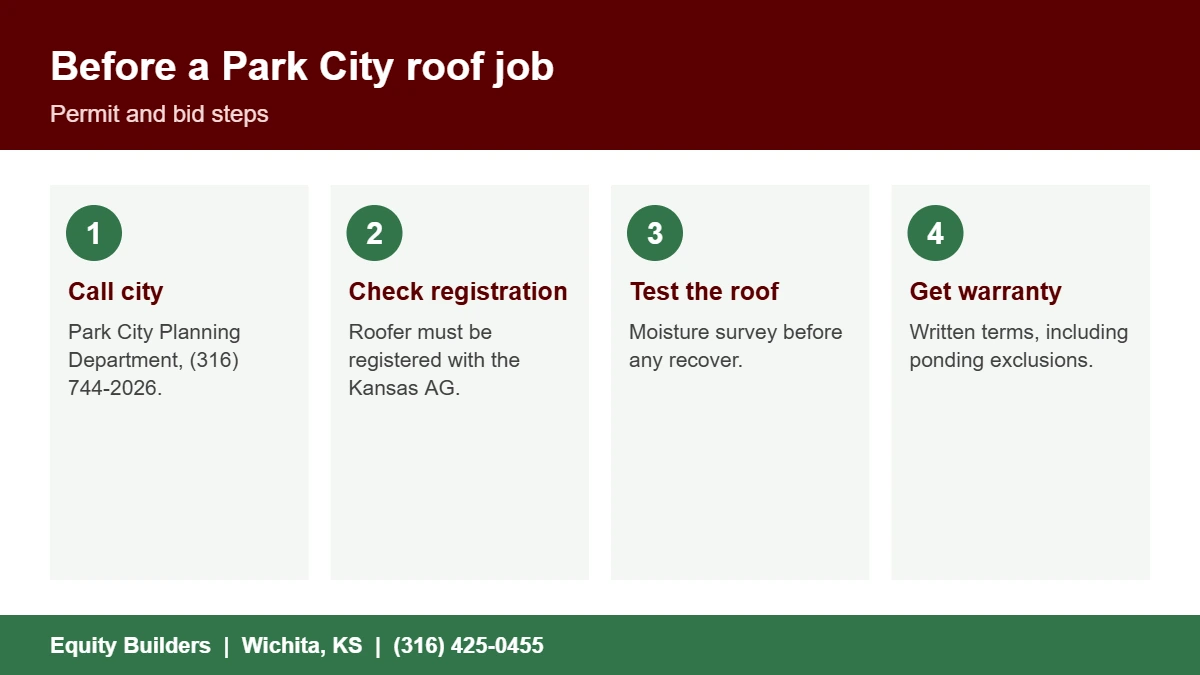
The city does. Park City is a Sedgwick County city north of Wichita along I-135, with 8,333 residents at the 2020 Census, according to Census 2020 tables from the University of Kansas. MABCD does not cover it. Its small cities page lists Park City, Planning Department, among the cities where you “contact them for permitting, licensing, plan review, inspections, etc.”
The city’s Licenses and Permits page links a building permit application, a contractor license application and a fee schedule. It sends questions to the Planning Department at (316) 744-2026. The page does not state roofing fees, so ask before you sign a bid.
State law also applies. Roofers must register with the Kansas Attorney General, and K.S.A. 50-6,135 requires the roofer to give the registration number to the permit office. See Kansas roofing contractor registration.
Which flat roof options fit warehouses and shops?
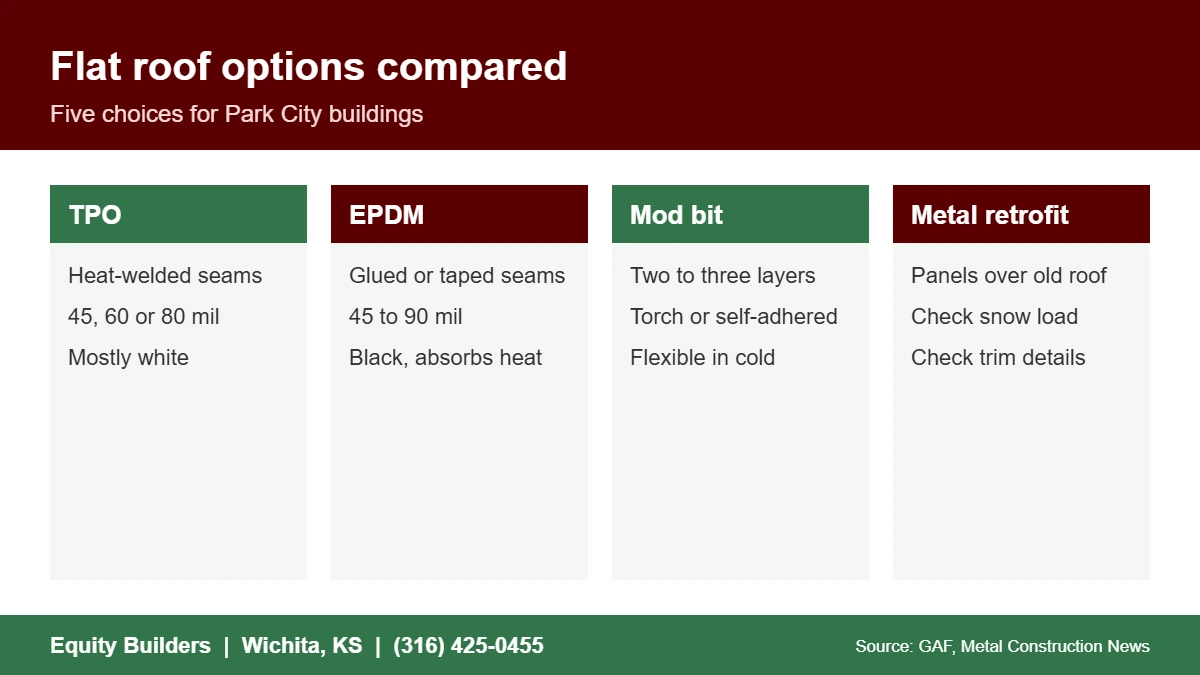
Park City has large flat roofs. Amazon announced a fulfillment center of about 1 million square feet at 7130 North Broadway Avenue in a 2020 news release. Smaller shops, offices and metal buildings share the same weather. This table summarizes the commercial roofing in Park City that owners compare, using manufacturer and trade sources.
| Option | Seams or system | Watch for |
|---|---|---|
| TPO | Heat-welded; 45, 60 or 80 mil | Seam quality at laps, ponding |
| EPDM | Glued or taped; 45 to 90 mil | Black color absorbs heat; seams are glue lines |
| Modified bitumen | Two to three layers, torch, cold-applied or self-adhered | Open flame limits on some jobs |
| Metal retrofit | New panels over old roof | Structure, snow load, trim details |
| Coating | Acrylic or silicone over old roof | Hides defects, short life |
For installation and repair on these roofs, see our commercial roofing in Wichita page.
How do TPO and EPDM differ?
The main difference is the seam. A GAF building science article says TPO seams “can be heat-welded, providing superior strength and longevity at the laps.” EPDM is a thermoset rubber, so its seams must be glued or taped.
TPO is mostly white. EPDM is naturally black, which gives high heat and UV resistance but absorbs heat. The Department of Energy says conventional roofs can reach 150 degrees F or more on a sunny summer afternoon, and a reflective roof can stay more than 50 degrees F cooler. Wichita’s July normal high is 92.6 F, according to the National Weather Service. DOE also notes that cool roofs carry a winter heating penalty.
Both membranes can be mechanically attached or adhered. GAF says EPDM can also be ballasted and that TPO is durable under ponding conditions, while EPDM can degrade when water stands for long periods.
What does ponding water do to a flat roof?
It speeds wear and adds weight. The Construction Specifier defines ponded water as “any accumulation of water that remains on the surface of the completed roof system 48 hours after the last rainfall.” A 1 inch depth adds about 5.2 pounds per square foot, per that article.
A Roofing magazine article on ponding says ARMA recommends a minimum slope of one quarter inch per foot. It adds that dirt, algae and freeze-thaw ice movement can damage the membrane surface.
Common causes include drains set too high, too few drains and missing waterways around rooftop units. Clogged drains make it worse. Fixes can include tapered insulation crickets, though structural steel and equipment can limit them. A leak that appears below a low spot is often a drainage problem; our guide to roof leak causes in Wichita covers others.
Can a new roof go over the old one?
Sometimes, but the warranty may change. The Construction Specifier reports that manufacturers often will not issue a no-dollar-limit warranty on a reroof unless all existing roofing is removed, or they add a disclaimer excluding ponding areas. Trapped moisture between old and new layers can compress insulation and create low spots. Cover boards typically go between the old roof and the new system.
Before a recover, take core samples or a moisture survey and ask the manufacturer in writing what it will warranty. Compare bids on the same scope. See how to choose a roofing contractor.
When does a metal retrofit make sense for a Park City building?
When the building already has a metal roof and the structure can carry it. Metal Construction News says all major panel types can be retrofitted, and that a TPO membrane adds no structural strength to the existing panels. The author is president of a retrofit company, so weigh the cost claims with care.
A 2015 Roofing Contractor article says a high-end standing seam retrofit can cost about the same as a single-ply system or as little as 25 percent more. It describes systems that work without added framing on 5 foot on-center purlins, with insulation placed between the old and new roofs. That is a vendor-reported figure, so ask for a bid.
Older metal buildings often fall short of current snow load requirements, which makes an engineer’s review worthwhile. Our metal roofing in Wichita page covers panel options.
Are roof coatings a real fix?
Only on a roof that is dry and sound. The same Metal Construction News article says coatings are short term, lasting 3 to 15 years, and can hide defects. Leaks under a coating can trap moisture and corrode the roof below.
Choose by ponding. A CertainTeed comparison says acrylic coatings can break down more quickly in standing water, while silicone performs better in ponding conditions. Acrylic typically goes on at 50 degrees F and rising, silicone at 35 degrees F and rising, which matters for fall and spring scheduling.
How do hail and wind affect commercial roofing in Park City?
Kansas ranks high for hail. The Insurance Information Institute counted 375 major hail events of 1 inch or larger in Kansas in 2025, second to Texas. An SGH brief says single-ply membrane damage can begin with hail of 1.5 inches or larger.
Wind attacks edges first. FM Global’s brochure on windstorm damage calls metal edge flashing the roof’s most important component and says corner uplift can exceed field uplift by more than 2.5 times. On metal buildings, MBCI says unsealed trim is typically where water enters after a storm. After a storm, read our guides to storm damage roof repair and roof repair in Wichita.
Commercial roofing in Park City: questions from owners
Can I coat a leaking flat roof instead of replacing it?
Only if the insulation underneath is dry. Metal Construction News says leaks under a coating can trap moisture, and coatings can hide defects. For commercial roofing in Park City, get a moisture survey first, then compare a coating bid against a recover or replacement.
Does Park City use MABCD for building permits?
No. MABCD lists Park City among cities that handle permitting, plan review and inspections themselves. Contact the Park City Planning Department at (316) 744-2026 to confirm what a roof replacement or recover needs.
Is a flat roof ever fully flat?
Not by design. Roofing magazine reports that ARMA recommends a minimum slope of one quarter inch per foot, achieved with sloped decks, tapered insulation and drains. Water left after 48 hours is considered ponding.
Get a bid for commercial roofing in Park City
Equity Builders is a Wichita general contractor, founded in 1985, that does residential and commercial roofing. Park City sits just north of Wichita on I-135. For commercial roofing in Park City, building owners can call (316) 425-0455, read about our commercial roofing work, or request a free estimate.
Sources
- City of Park City, Licenses and Permits; Sedgwick County MABCD, contracted small cities
- U.S. Census Bureau 2020 tables via University of Kansas; Amazon news release, October 16, 2020
- GAF, single-ply membrane types and comparison; GAF, SBS roofing
- Construction Specifier, better drainage for low-slope roofs; Roofing magazine, ponding water basics
- Metal Construction News, metal-over-metal retrofits; Roofing Contractor, April 2, 2015
- CertainTeed, acrylics vs silicone; U.S. Department of Energy, cool roofs
- Insurance Information Institute, hail statistics; SGH hail brief; FM Global P0283; MBCI
- National Weather Service Wichita, climate normals
Last updated October 29, 2026. Permit rules, fees and warranty terms change, so confirm with the Park City Planning Department and the membrane manufacturer.