
Flat roof repair in Wichita usually means fixing one of five things: open seams, failed flashing, blisters, clogged drains or hail punctures. Water that sits on the roof more than 48 hours after rain is ponding, and it is the most common reason a low-slope roof wears out early. Patch the leak, then fix the drainage, or the same spot will fail again.
This guide covers the common problems on Wichita homes, shops and commercial buildings, when a repair stops making sense, and what the local building department requires.
What counts as a flat roof?
Very few roofs are truly flat. The building code calls them low-slope roofs, and it requires most of them to drain. The International Building Code sets a minimum design slope of one-fourth unit vertical in 12 units horizontal, a 2 percent slope, for built-up, modified bitumen and single-ply membrane roofs. MABCD, the Wichita and Sedgwick County building department, has enforced the 2024 edition of that code for commercial plans since January 1, 2025, according to its Building Division page.
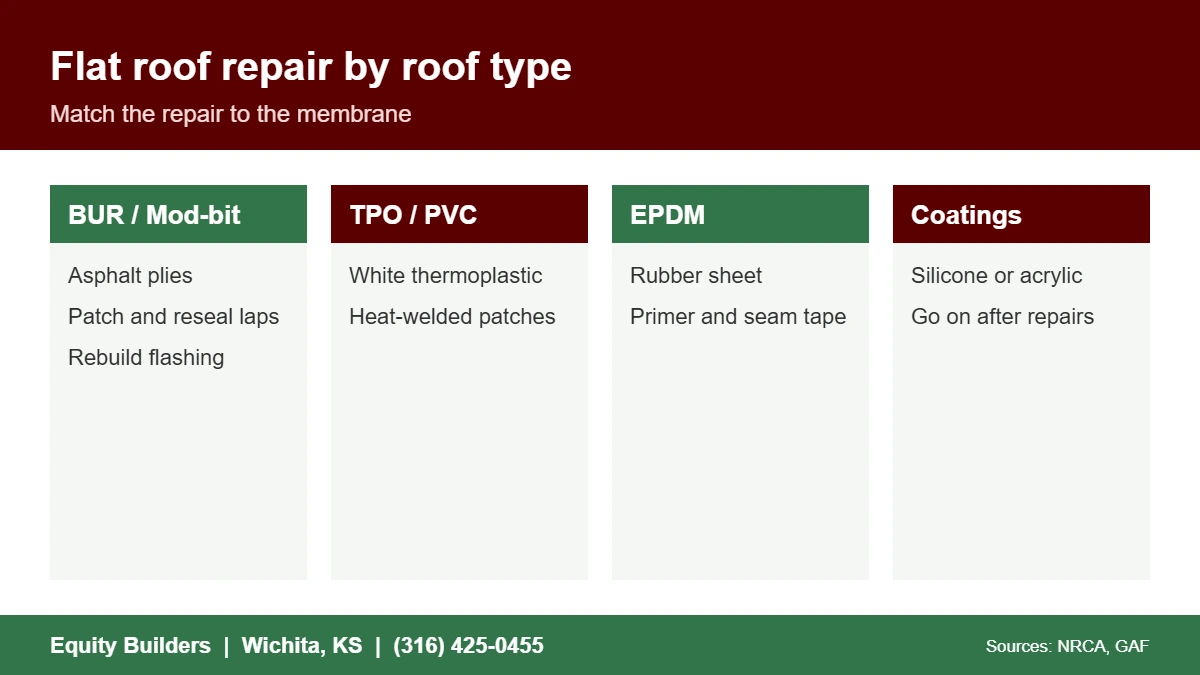
| System | What it is | Typical repair |
|---|---|---|
| Built-up roof (BUR) | Layers of felt and asphalt, often with gravel | Cut out blisters, add plies, rebuild flashing |
| Modified bitumen | Rolled asphalt sheets, torch or cold applied | Patch over cleaned area, reseal laps |
| TPO and PVC | White thermoplastic sheets with heat-welded seams | Heat-weld a patch of the same membrane |
| EPDM | Black or white rubber sheets with taped seams | Clean, prime and tape or adhere a patch |
| Coatings | Silicone or acrylic applied over a sound roof | Recoat worn areas after repairs |
On houses, low-slope sections usually cover porches, carports, additions and dormers. Many leaks start where that flat section meets the steeper main roof, so the flashing at that joint gets checked first.
What causes most flat roof leaks in Wichita?
Ponding water
The National Roofing Contractors Association defines ponding as water “that remains more than 48 hours after precipitation” under conditions conducive to drying. Low spots form where insulation compresses, framing sags or drains sit too high. Standing water speeds up wear on many surfaces. GAF warns that ponding “can be detrimental to the long term performance of acrylic coatings.”
Wichita’s weather makes it worse. The National Weather Service counts 65 days a year at 90 degrees or hotter and 16 days that stay at or below freezing, based on 1991 to 2020 normals. A pond that bakes in July can freeze solid in January.
Seams and flashing
Most flat roof leaks start at an edge or a joint: membrane laps, walls, parapets, curbs under rooftop units, pipe penetrations and skylights. Sealant at these points dries out and pulls loose. A flat roof repair that only smears sealant over a failed seam rarely lasts a season.
Blisters and wet insulation
Blisters form when moisture or air is trapped between plies or under the membrane. Small, intact blisters are often watched rather than cut. Large or broken ones let water into the insulation. Wet insulation is hard to see from the surface. ASTM C1153 describes infrared imaging at night to find it.
Clogged drains and scuppers
Leaves, granules and debris collect at drains and scuppers. Once they block, water backs up over flashing that was never meant to sit underwater. Homes with low-slope porch roofs drain into gutters, and those clog the same way. See how clogged gutters cause roof damage.
Hail and wind
Engineering firm Simpson Gumpertz and Heger reports that single-ply membrane damage “can occur with hail 1.5 in. or larger.” Wichita has seen far more than that. On September 3, 2025, the National Weather Service logged hail up to 2.75 inches in Wichita and a 71 mph gust at McConnell Air Force Base. Wind lifts edge metal and coping first.
Repair, recover or replace?
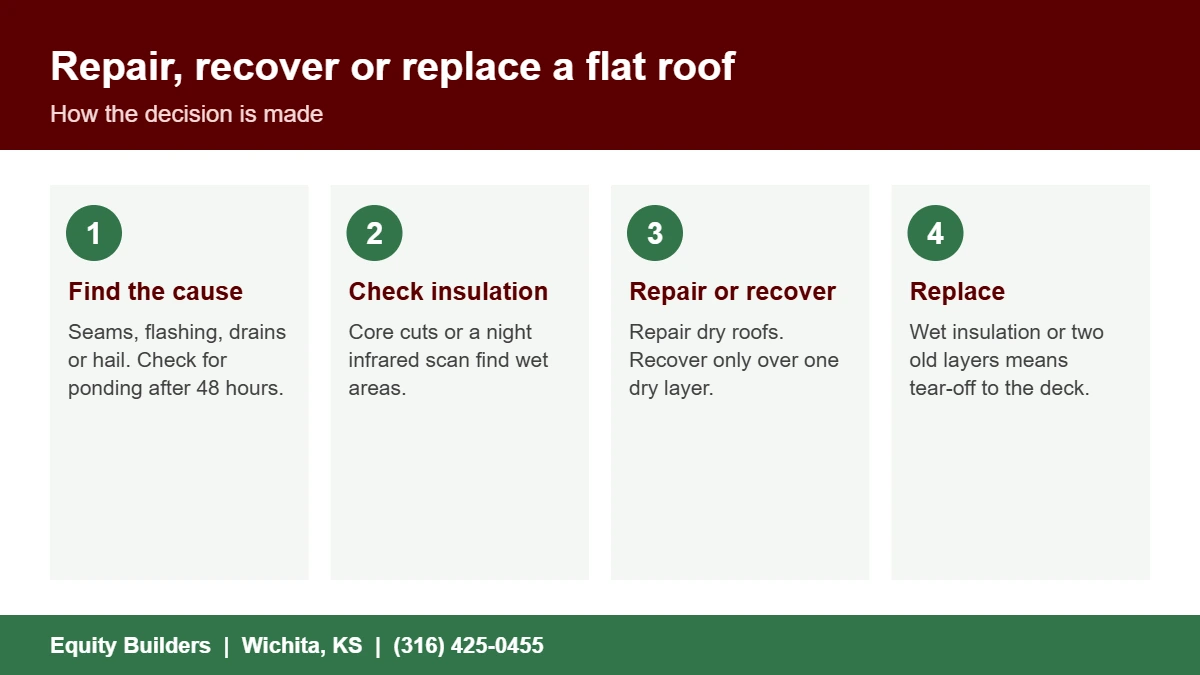
A flat roof repair makes sense when the problem is limited and the insulation underneath is dry. When the damage is spread out, the code decides some of the options.
- Repair. Isolated seam, flashing or puncture problems on a roof with dry insulation.
- Recover. A new membrane over the old one. The 2018 residential code Wichita uses does not allow a recover where the existing roof is water-soaked or deteriorated, or where it “has two or more applications of any type of roof covering.” The commercial code sets similar limits, so ask MABCD before planning a recover on a commercial building.
- Replace. Remove all layers down to the deck. This is the answer for wet insulation across large areas or a roof with two old layers.
Are roof coatings worth it on a flat roof?
They can be, on the right roof. A coating is not a fix for wet insulation or failed seams. Those get repaired first. GAF’s coatings guidance says silicone “Can stand up to ponding water,” while acrylic does better on roofs that drain well. GAF notes that coating guarantees run up to 20 years, depending on the contractor’s certification level.
Do I need a permit for flat roof repair in Wichita?
Small repairs are usually exempt. Larger work needs a permit from MABCD. The MABCD fee schedule lists roofing at $0.05 per square foot with a $50 minimum and a $1,500 maximum. MABCD treats everything other than one- and two-family homes as commercial, and commercial projects start with plan review and need separate permits for each trade. See our Wichita roof permit guide for the residential rules.
Every roofing contractor in Kansas also needs state registration. The Kansas Roofing Registration Act covers “commercial or residential roofing services.” Here is how to look up a roofer’s registration.
How often should a flat roof be inspected?
Twice a year and after storms. NRCA recommends inspections “at least twice per year, preferably in the spring and fall,” with extra checks after hail. After a storm, NRCA advises owners to look from the ground and leave closer assessment to a professional roofing contractor.
Keep a simple record: photos of drains, seams and flashing each spring and fall, plus the date of every leak. That record speeds up any flat roof repair and supports an insurance claim if a storm hits.
Flat roof repair questions
How much does flat roof repair cost?
It depends on the membrane, the size of the damaged area and whether insulation is wet. A seam patch costs far less than cutting out and replacing soaked insulation. An on-roof inspection, with core cuts or an infrared scan when needed, is the only way to price it.
What is the best way to repair a flat roof?
Match the repair to the membrane. TPO and PVC take heat-welded patches. EPDM takes primer and seam tape or adhered patches. Built-up and modified bitumen roofs take compatible plies and flashing. Coatings go on after repairs, not instead of them.
Will insurance pay for a leaking flat roof?
Policies generally cover sudden damage such as hail or wind, not wear, ponding or old seams. For a home, see what to do if a roof claim is denied. Kansas licenses public adjusters for commercial lines claims.
How long does a flat roof last?
It depends on the system, drainage and upkeep. The EPDM Roofing Association, a trade group, reported in 2026 that its survey showed EPDM membranes lasting “at least 38 years.” Treat any single number as a best case.
Get a flat roof repair estimate in Wichita
Equity Builders repairs and replaces low-slope roofs on homes, shops and commercial buildings from 442 S. Ellis St. in Wichita, where we have worked since 1985. We find the cause, fix the drainage and give you a written scope for each flat roof repair. See our commercial roofing and roof repair pages, then call (316) 425-0455 or request a free estimate.
Sources
- National Roofing Contractors Association, roofing glossary and Professional Roofing, November 2020
- MABCD Building Division and permit fee schedule
- 2018 International Residential Code reroofing provisions and MABCD commercial code adoption (2024 IBC and IEBC)
- GAF, commercial roof coatings and technical bulletin TAB-C-47
- Simpson Gumpertz and Heger, hail damage topic brief, 2026
- National Weather Service Wichita, climate normals and September 3, 2025 storm summary
- Kansas Statutes Annotated 50-6,122
Last updated October 14, 2026. Building codes and fees change. Confirm current requirements with MABCD.