

Roof replacement in College Hill is a different job from reroofing a 1990s house in west Wichita. Most homes between Hillside and Oliver were built from 1884 to 1935. They have steep rooflines, brick chimneys and board decking that the local building department no longer accepts under new shingles. Plan for those items before you compare bids.
These seven things shape the scope, the schedule and the look of a roof replacement in College Hill.
1. What makes College Hill roofs different?
Age and style. The City of Wichita describes College Hill as one square mile about 2.5 miles east of downtown, bounded by Central, Kellogg, Hillside and Oliver. A design guide the city published in 1998 counted roughly 120 city blocks and found that houses went up “primarily between 1884 and 1935.”
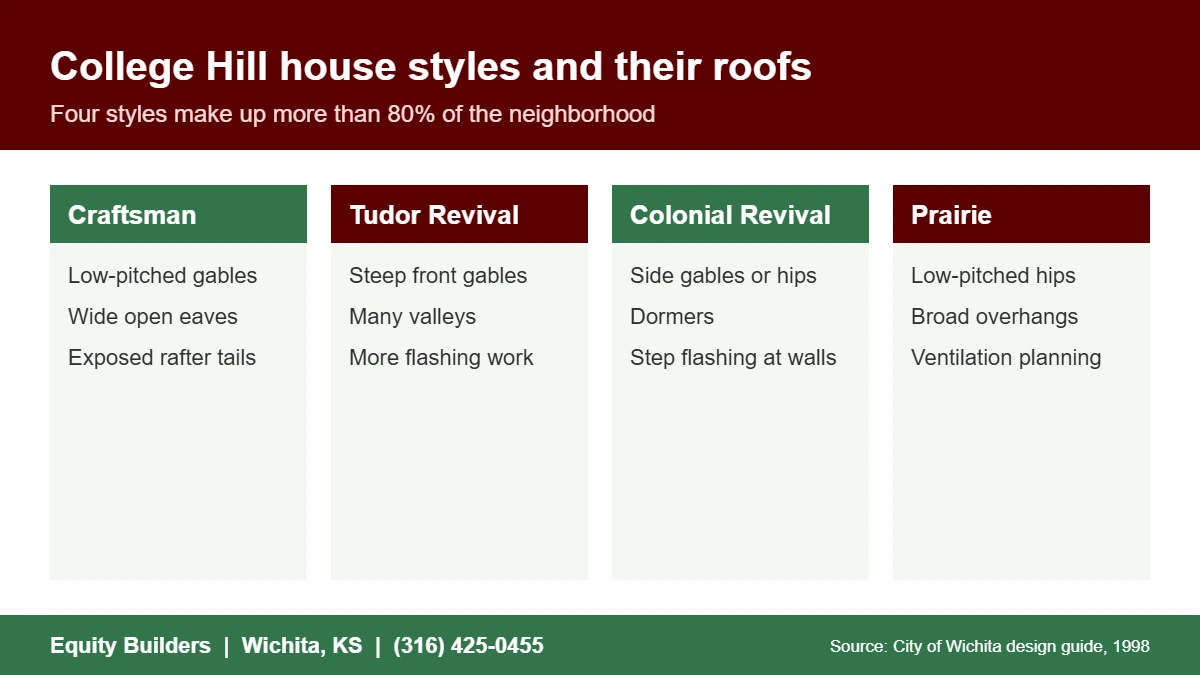
The same study found that more than 80% of the houses fall into four styles: Craftsman, Tudor Revival, Colonial Revival and Prairie. Each one carries its character in the roof.
| Style | Typical roof shape | What it means for replacement |
|---|---|---|
| Craftsman | Low-pitched gables, wide open eaves, exposed rafter tails | Eave and rafter tail repairs, careful drip edge detail |
| Tudor Revival | Steep front-facing gables, many valleys | Steep-slope labor, more flashing and valley work |
| Colonial Revival | Side-gabled or hipped, often with dormers | Dormer flashing and step flashing at walls |
| Prairie | Low-pitched hips, broad overhangs | Long eaves, ventilation planning |
2. Will my old board decking pass inspection?
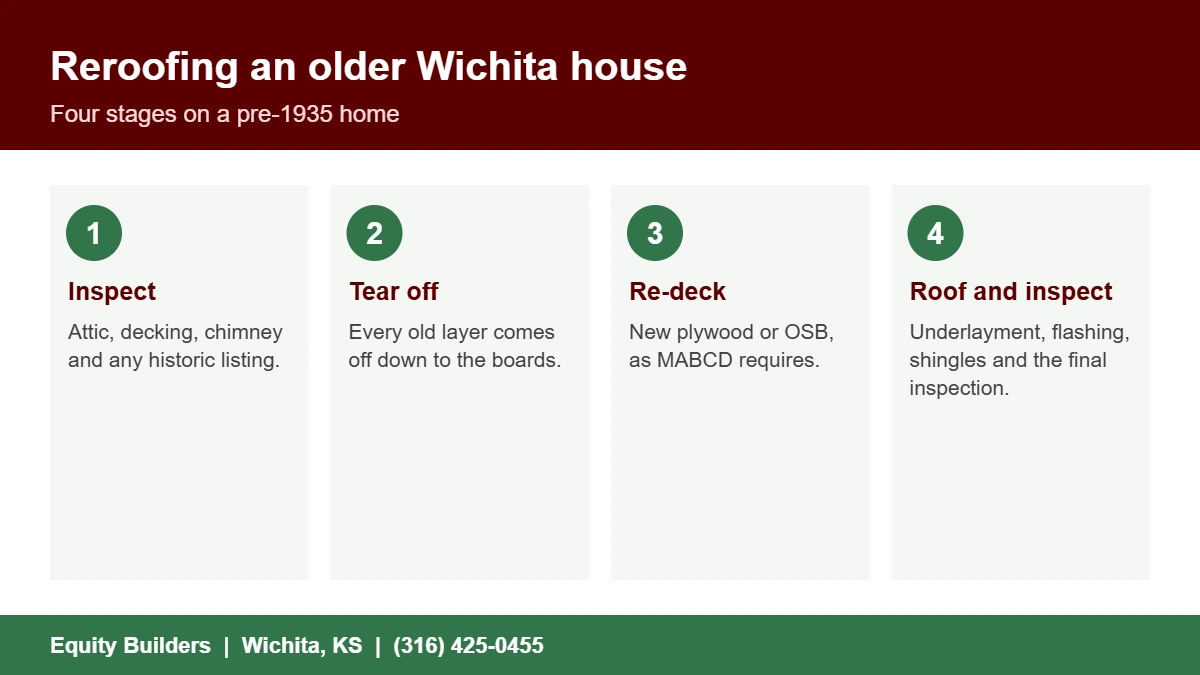
No, not as the finished deck. MABCD, the building department for Wichita and Sedgwick County, stated the rule in its October 2025 newsletter: “Sedgwick County jurisdiction also requires plywood or OSB for roof decking. Plank decking is not accepted within MABCD jurisdiction.”
Houses of this age were framed before plywood was a standard building product, so 1x boards under the shingles are the norm. A roof replacement in College Hill should include new plywood or OSB sheathing in the bid, priced by the sheet or by the square. If a bid is silent on decking, ask. Our guide to roof decking during a replacement explains the work.
3. How many layers have to come off?
All of them. Expect a roof replacement in College Hill to be a full tear-off. A house that has stood for 90 to 140 years has been reroofed several times, and older layers were often left in place. The 2018 International Residential Code, which MABCD enforces, does not allow new roofing over a roof that already has two or more layers. The local permit form asks whether the job removes one layer, two layers or includes a re-deck.
A full tear-off has an upside. It is the only time anyone sees the rafters, the tops of the walls and the chimney base. Rot and old leak damage get fixed while the deck is open.
4. Which roofing material fits a College Hill house?
College Hill is not regulated like Old Town or the other local historic districts. The city’s design guide says so directly: “This document is for voluntary use by property owners.” Its advice is still the best local reference for what looks right.
- “Sloping roofs such as gable and hipped roofs are appropriate for primary roof forms.”
- “Materials similar to those seen traditionally are preferred. These include clay, tile and wood.”
- Composition shingles “may be appropriate if they convey a scale and texture similar to those seen traditionally.”
The National Park Service gives the same guidance for older buildings across the country. Preservation Brief 4 says that when a roof is readily visible, a substitute material “should match as closely as possible the scale, texture, and coloration” of the original.
In practice that points to three options:
- Architectural or designer asphalt shingles with a thick, shadowed profile. This is the most common choice.
- Composite slate or shake for houses that once had slate or wood shingles.
- Clay or concrete tile where tile is original. The W.O. Van Arsdale House at 201 N. Broadview, built in 1922 and listed on the National Register in 2009, has what the Kansas Historical Society calls a “low-pitched roof with red Spanish tile.”
Our overview of the best roofing materials for Wichita homes compares cost and service life.
5. Does a historic listing limit my choices?
It can. The neighborhood guide is voluntary, but individual properties are a separate matter. The Wichita Historic Preservation Office reviews Certificate of Appropriateness applications under the city’s preservation ordinance. That ordinance covers more than 600 structures on the local, state and national registers.
College Hill has several listed properties. The Allen-Lambe House at 255 N. Roosevelt, the only Frank Lloyd Wright house in Kansas, is the best known. If your house is listed, or you are not sure, call the preservation office at 316-268-4421 before you sign a roofing contract or change materials.
6. What permit and inspection does the job need?
Every roof replacement in College Hill needs a roofing permit from MABCD and a final inspection. The fee is $0.05 per square foot of the building footprint, with a $50 minimum, so a house with a 1,500 square foot footprint pays $75. The roofer schedules the final inspection when the work is done. Our article on the Wichita roof replacement permit covers who pulls it and what gets checked.
Inspectors also apply the attic ventilation section of the residential code. Many older houses have little or no intake venting at the eaves, and open Craftsman eaves leave few places to add it. Ask how the new roof will bring air in and let it out. See roof ventilation in Wichita for the options.
7. How do hail and insurance affect an older roof?
Hail threshold research by Haag Engineering puts the start of damage at about 1 inch for 3-tab shingles and 1.25 inches for laminated shingles. Many thick designer shingles and composite products are sold with a Class 4 impact rating, which suits a neighborhood where the roof is a large part of the street view.
Check your policy before the next storm. Insurers often move older roofs to actual cash value, which subtracts depreciation from a claim. Code-required work such as new decking should be in the scope sent to the adjuster. See ACV vs RCV roof coverage.
Questions about roof replacement in College Hill
How much is a new roof in Wichita?
It depends on roof area, pitch and material. In College Hill, a re-deck, extra tear-off layers, steep gables and chimney flashing add to the base price. Our page on roof replacement cost in Wichita gives typical ranges. A measured bid is the only firm number.
What is the 25% rule for roofing?
The “25% rule” people search for is best known from Florida’s building code. The rule Wichita owners run into is different. Local code exempts roofing repairs of 400 square feet or less in a 12 month period from the permit requirement. Larger jobs need a permit.
Should a 20-year-old roof be replaced?
Not on age alone. The InterNACHI life expectancy chart lists 20 years for 3-tab shingles and 30 for architectural shingles. Curling, bare spots, leaks or soft decking are better reasons. Compare the options in roof repair vs roof replacement.
How long does the job take on an older house?
Most tear-offs take one to three working days. A full re-deck and steep slopes add time. See how long a roof replacement takes in Wichita.
Get a bid for roof replacement in College Hill
Equity Builders has worked from 442 S. Ellis St. since 1985. Our shop is less than two miles west of Hillside. A bid for roof replacement in College Hill from us lists the decking, tear-off layers, flashing and ventilation line by line, so you can compare it with any other. Read more about roof replacement in Wichita and roofing older Wichita homes, then call (316) 425-0455 or request a free estimate.
Sources
- Winter and Company for the City of Wichita, Design in the College Hill Neighborhood, September 1998
- City of Wichita, College Hill neighborhood page and Historic Preservation Office
- MABCD Construction Industry Newsletter, Issue 53, October 2025, and the MABCD fee schedule
- National Park Service, Preservation Brief 4: Roofing for Historic Buildings
- Kansas Historical Society, National Register listing for the W.O. Van Arsdale House
- Haag Engineering, hail damage threshold sizes for common roofing materials
Last updated October 7, 2026. Codes and fees change. Confirm current requirements with MABCD and the Historic Preservation Office before work begins.