ACV vs RCV roof insurance comes down to one question: does your policy subtract depreciation from a roof claim? A replacement cost value (RCV) policy pays to replace the roof at today’s prices, minus your deductible. An actual cash value (ACV) policy pays only what the old roof was worth on the day of the storm.
On a Wichita roof that has taken 10 or 15 Kansas hail seasons, that difference can run well past $10,000. This ACV vs RCV guide shows the math with local numbers, how to find out which coverage you have, and what to ask your agent before the next storm crosses Sedgwick County.
ACV vs RCV roof insurance: the short answer
- RCV pays the cost of a new roof minus your deductible. Nothing is taken off for age.
- ACV pays the cost of a new roof minus depreciation, then minus your deductible.
- A roof payment schedule is a table in the policy that sets the percentage paid by roof age and material. It usually applies to wind and hail only.
- In Kansas the wind and hail deductible is often a percentage of your dwelling coverage, not a flat dollar amount.
How does the Kansas Insurance Department define ACV and RCV?
The Kansas Insurance Department’s Home and Renters Insurance Shopper’s Guide defines the two terms this way:
- Actual cash value: “The amount it would take to repair or replace damage to your home after accounting for wear and tear (depreciation).”
- Replacement cost: “The amount it would take to repair or rebuild your home or replace damaged property with materials of similar kind and quality at today’s price.”
The department also lists one question every Kansas homeowner should put to an insurer: “Is my coverage replacement cost or actual cash value?”
How is ACV calculated on a roof?
The adjuster prices a new roof, then subtracts depreciation. The National Association of Insurance Commissioners (NAIC) says insurers look at “the condition of the property when it was lost or damaged, what a new item would cost, and how long the item would normally last.”
The NAIC’s own example uses two families with the same $15,000 in roof damage and the same $1,000 deductible. The family with RCV coverage collects $14,000. The family with ACV coverage collects $4,000, because the insurer subtracts $10,000 in depreciation first.
Some policies skip the adjuster’s judgment and use a roof payment schedule instead. Insurance trade publication Rough Notes described one national carrier’s table in January 2026: a six-year-old asphalt shingle roof is paid at 82 percent.
What does ACV vs RCV look like on a Wichita roof?
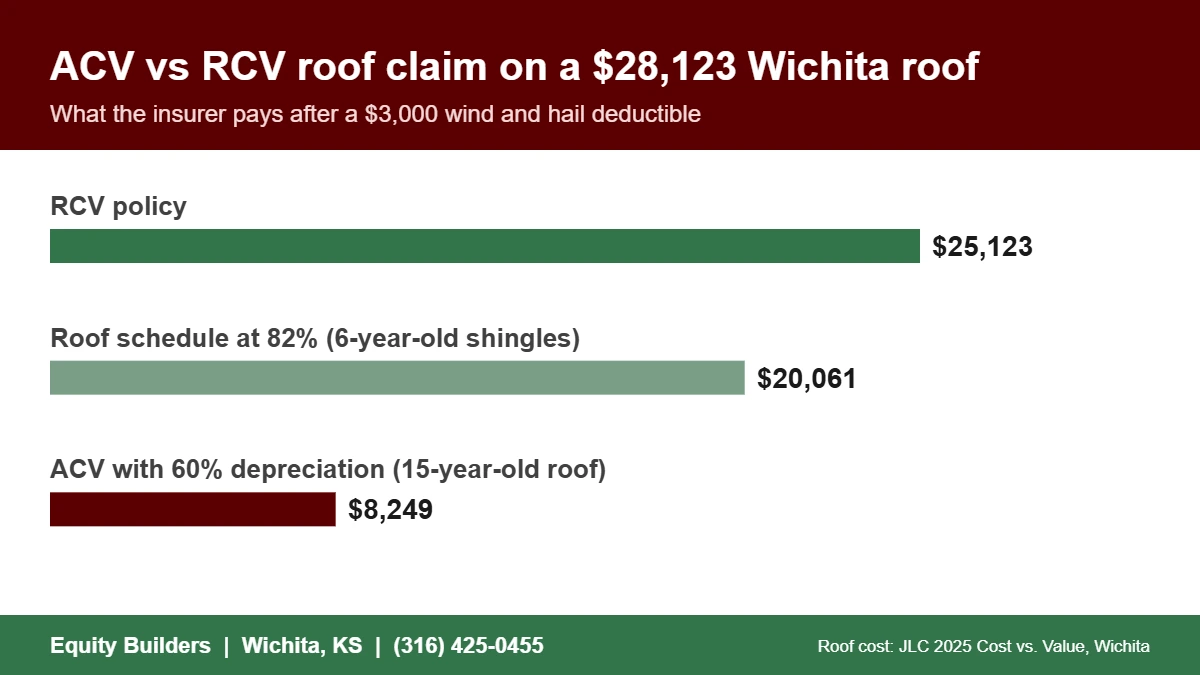
The 2025 Cost vs. Value Report from the Journal of Light Construction prices a 30-square asphalt shingle tear-off and replacement in Wichita at $28,123. Here is how one hail claim on that roof pays out under three policies. The example assumes a home insured for $300,000 with a 1 percent wind and hail deductible, which is $3,000.
| Policy type | Depreciation taken | Insurer pays | You pay |
|---|---|---|---|
| RCV | $0 | $25,123 | $3,000 |
| Roof schedule at 82 percent (six-year-old shingles) | $5,062 | $20,061 | $8,062 |
| ACV with 60 percent depreciation (15-year-old roof, illustration) | $16,874 | $8,249 | $19,874 |
The 60 percent row is an illustration, not a figure from any carrier. Your policy’s own wording sets the method. The Kansas Insurance Department notes that most homeowner policies carry a separate wind and hail deductible “that is generally one to two percent of the amount of insurance carried on the structure.” On the same $300,000 home, a 2 percent deductible would be $6,000.
Why are RCV roof claims paid in two checks?
Most replacement cost policies pay the actual cash value first. The held-back depreciation, often called recoverable depreciation, is released after the roof is replaced and the insurer receives the final invoice. If the work is never done, the homeowner normally keeps only the first check.
Keep every invoice and make sure it shows the true price, because the insurer pays recoverable depreciation against what the job actually cost. A contractor who offers to cover your deductible by changing the invoice is asking you to sign a false claim document. We explain the Kansas statute involved in can a roofer pay my deductible in Kansas.
How do I tell if I have ACV or RCV on my roof?
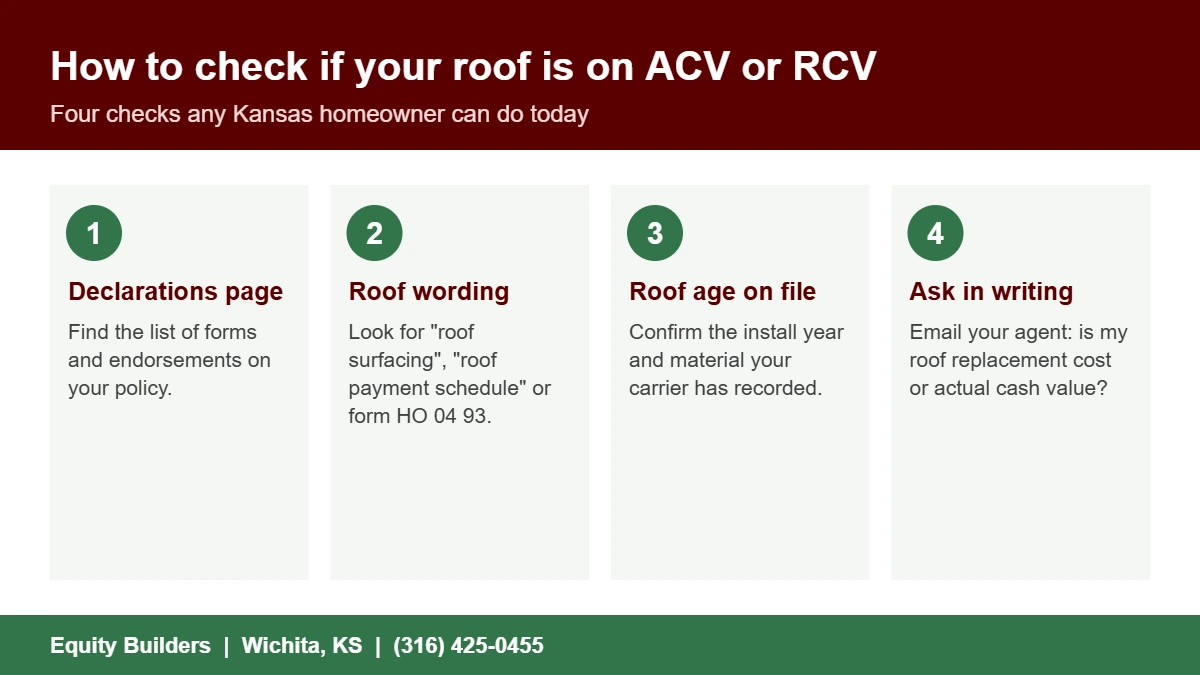
- Read the declarations page. It lists every form and endorsement attached to the policy.
- Look for roof wording. Phrases such as “Actual Cash Value Loss Settlement Windstorm or Hail Losses to Roof Surfacing” (ISO form HO 04 93), “roof payment schedule” or “limited loss settlement” mean the roof is not on full replacement cost for wind and hail.
- Check the roof age on file. Some carriers print the installation year and material on the declarations page and update it when a licensed contractor documents a new roof.
- Read your renewal notice. United Policyholders, a national consumer nonprofit, advises reading renewals closely because insurers in several states have moved roofs to ACV options.
- Ask in writing. Email your agent the Kansas Insurance Department’s question and keep the reply.
Which is better for Wichita homeowners, ACV or RCV?
RCV costs more in premium and pays more at claim time. ACV lowers the premium and moves the cost of an aging roof onto you. The right choice depends on roof age and the cash you could put toward a roof on short notice.
Hail is the reason ACV vs RCV matters here. The Kansas state record hailstone, 7.75 inches across, fell near Pawnee and 119th Street West in Wichita on September 15, 2010, according to the National Weather Service. On June 13, 2026 the Weather Service logged 4-inch hail four miles north of Winfield and a 64 mph gust at Eisenhower National Airport. Roofs from Riverside and College Hill to Maize and Derby sit in that path every spring.
- Roof under 10 years old: depreciation is small, so the gap between the two is small. RCV is still the safer coverage.
- Roof 10 to 20 years old: this is where ACV costs the most at claim time.
- New roof: send your agent the invoice and ask that the roof age be updated. On a schedule policy a documented new roof starts back at the top of the table. An HO 04 93 endorsement applies no matter how new the roof is. Ask too whether Class 4 impact-resistant shingles earn a discount with your carrier.
What should I do before filing a hail claim in Wichita?
Settle the ACV vs RCV question and know the roof’s real condition before you call the insurer. On an ACV policy, a claim for light damage to an old roof can pay less than the deductible. A roof inspection from a local contractor gives you something to set beside the adjuster’s estimate. Our roof insurance claims page explains how Equity Builders works with adjusters, and our guide to filing a roof insurance claim in Wichita covers each step. For replacement pricing, see roof replacement cost in Wichita.
Kansas regulation K.A.R. 40-1-34 gives an insurer 10 working days to acknowledge a claim and 15 working days after it receives proof of loss to accept or deny it. If the answer is no, read what to do when a roof insurance claim is denied in Kansas.
Call (316) 425-0455 or request a free estimate. Equity Builders has worked from 442 S. Ellis St. in Wichita since 1985.
ACV vs RCV questions Wichita homeowners ask
What is the actual cash value of a 20 year old roof?
It depends on the policy’s method. Under a straight age-based approach, a 20-year-old shingle roof with a 25-year expected life has lost about 80 percent of its value. A $28,123 roof would be valued near $5,600 before the deductible. A payment schedule may set a different percentage, so ask your insurer for the schedule in writing.
Can I switch my roof from ACV to RCV?
Ask your agent. Rough Notes reports that some carriers offer their own endorsements that restore replacement cost on the roof. If yours does not, you can compare other companies. The Kansas Insurance Department’s Consumer Assistance Hotline, 800-432-2484, answers coverage questions.
Who do I call if I disagree with the depreciation on my claim?
Start with the adjuster and ask for the depreciation worksheet. If you cannot reach agreement with the company, the Kansas Insurance Department says to call its Consumer Assistance Hotline at 800-432-2484 or visit insurance.kansas.gov.
Sources
- Kansas Insurance Department, Home and Renters Insurance Shopper’s Guide
- Kansas Insurance Department, Home and Renters Insurance
- NAIC, Rebuilding After a Storm: Know the Difference Between Replacement Cost and Actual Cash Value, July 22, 2021
- United Policyholders, Roof insurance: ACV versus replacement cost, updated January 19, 2023
- Rough Notes, Homeowners Roof Surfacing Coverage Considerations, January 30, 2026
- Journal of Light Construction, 2025 Cost vs. Value Report, Wichita, KS
- National Weather Service Wichita, event summaries for September 15, 2010 and June 13, 2026
- Kansas Administrative Regulation 40-1-34
Last updated October 7, 2026. General information only. Your policy wording controls your claim.