
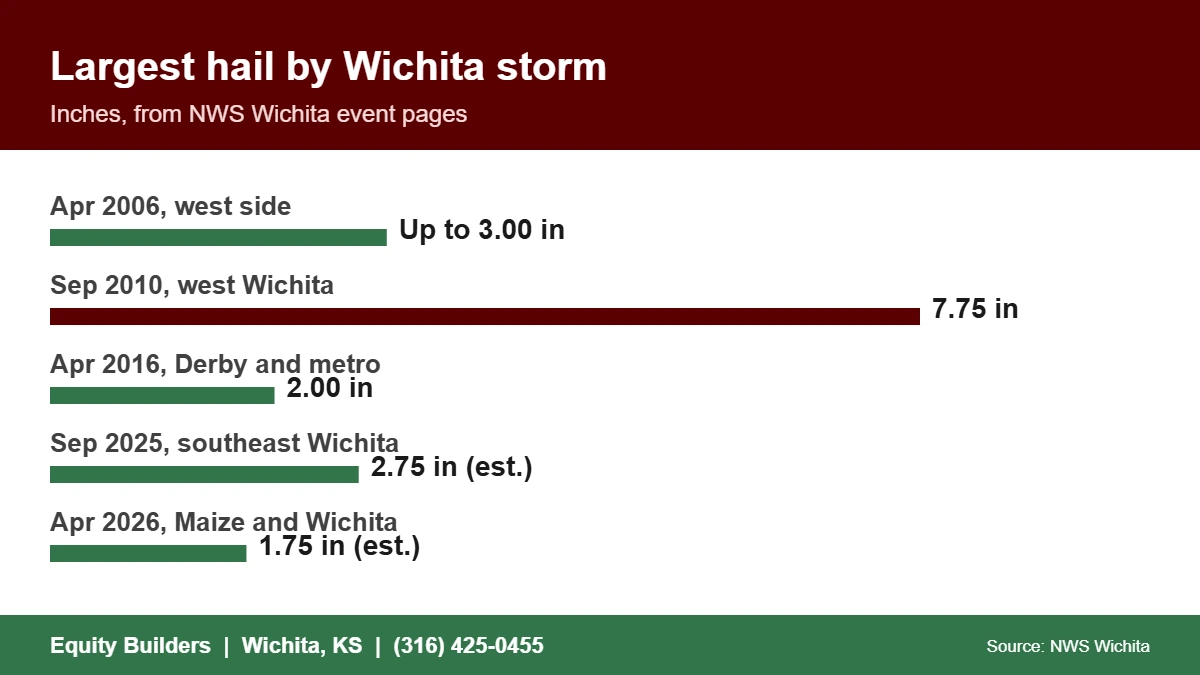
Wichita hail history includes many storms with stones of 1 inch or larger, and a few far above that: 2.00 to 3.00 inch hail on April 24, 2006, a 7.75 inch stone on September 15, 2010 and an estimated 2.75 inch stone on September 3, 2025. Storms follow their own tracks, and several parts of the metro have been hit in the last ten years.
This guide lists the major storms from National Weather Service pages, shows which parts of the metro they hit and explains what the record can and cannot tell you.
What does Wichita hail history show?
Three patterns stand out in the Wichita hail history on NWS Wichita event summaries.
- Big storms come in spring and early fall. The events below fall in April, May, June and September.
- Sizes of 1.75 to 2.00 inches are common in big events. Haag Engineering puts the damage threshold at 1.00 inch for 3-tab shingles and 1.25 inches for laminated shingles, so these stones are well above it.
- Counts swing from year to year. A KAKE analysis of storm reports found no clear upward trend.
Which hailstorms stand out in Wichita hail history?
Two storms set the scale. On April 24, 2006, supercells formed just west of the city around 6:30 a.m. and moved through during the morning rush hour. The NWS Wichita page cites widespread baseball size hail and $70 million in damage across Wichita.
On September 15, 2010, hail fell across Maize, Goddard, western Wichita, and near Haysville and Derby, with a swath from Goddard to Udall. The event also produced six confirmed tornadoes in the region.
This table uses only Sedgwick County and Wichita-area figures stated on NWS Wichita event pages. Sizes are the largest reported there, measured or estimated.
| Date | Where in the metro | Largest size reported |
|---|---|---|
| April 24, 2006 | West side, Maple and Maize area | 2.00 to 3.00 inches, about $70 million damage |
| September 15, 2010 | West Wichita, Maize, Goddard to Udall | 7.75 inches |
| April 26, 2016 | Citywide, from Derby to Bel Aire | 2.00 inches |
| June 15, 2016 | Colwich and Valley Center | 2.00 inches at Colwich |
| June 18, 2019 | 21st and Tyler, 21st and Maize | Up to 2 inches |
| May 3, 2020 | Near Wichita, Valley Center | Golf ball size |
| September 3, 2025 | Southeast, downtown, Park City, Valley Center | 2.75 inches (estimated) |
| April 25, 2026 | Maize, northwest and east Wichita | 1.75 inches (estimated) |
The 2006 and 2010 rows are older than a decade but are the two storms people still measure others against. Smaller storms matter too. On May 29, 2018, NWS Wichita photos show hail denting vehicles in the KNSS Studios lot at Douglas and Rock, though the page gives no size.
Which parts of Wichita get hit by hail?
The best area-by-area record in Wichita hail history is the April 26, 2016 summary. It lists more than 40 Sedgwick County hail reports by location:
- West. 1.25 inches (measured) at 135th and Kellogg and 1.75 inches (measured) in west Wichita. Goddard reported 0.75 inch.
- South. 1.75 inches (measured) at Pawnee and I-135, 1.75 inches at McConnell AFB and 1.75 inches 2 NW of Haysville.
- Southwest. 2.00 inches (measured) 3 W of Derby.
- Central and east. 2.00 inches (measured) 2 E of downtown, 1.50 inches (estimated) in College Hill and 1.50 inches (measured) in Bel Aire.
The June 18, 2019 page adds more west side locations: hail just smaller than baseballs fell at 21st and Tyler and at 21st and Maize, and the same storms flooded Andover Road and Kellogg and Woodlawn that afternoon.
Other years hit other areas. The September 3, 2025 reports include 1.75 inches (measured) in both Park City and Valley Center. The April 25, 2026 reports include 1.75 inches (estimated) 3 SSW of Maize and 1.00 inch near Andover.
The June 13, 2026 supercell went the other way. Its 4.00 inch stone fell 4 N of Winfield, while Eisenhower Airport recorded a 64 mph gust.
Does every severe storm in the region hit Wichita?
No, and that matters for reading the record. Several large NWS events logged no Sedgwick County hail at all:
- May 26, 2021: the page states no hail reports in Sedgwick County or the Wichita area.
- June 4, 2024: one report in the metro, 0.75 inch at Eisenhower Airport.
- April 22, 2025: stones to 2.50 inches fell at Pretty Prairie in Reno County, but none in Sedgwick County.
- April 23, 2026: stones to 4.00 inches in Marion County. Butler County reported 1.75 inches (measured) in Andover.
So a neighbor 20 miles away is a weak guide to your roof. Check reports for your own address and date.
How often does Wichita get hail?
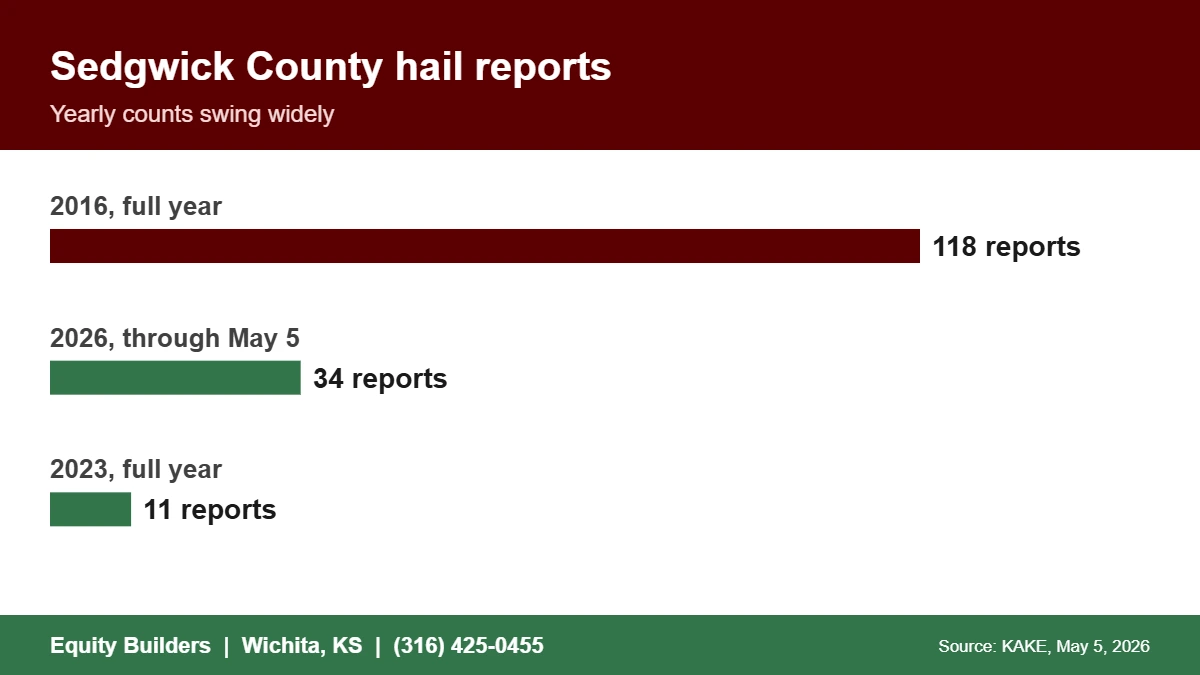
A KAKE analysis dated May 5, 2026 counted 34 Sedgwick County hail reports for the year so far, more than double the typical number for that date. It found 2016 was the worst year in its dataset with 118 reports and 2023 the quietest with 11.
The same piece notes that late May and June historically bring the most hail to south-central Kansas. It also warns that reports come from spotters, officials and the public, so dense areas like Wichita generate more reports than rural ground.
Statewide, the Insurance Information Institute counted 375 major hail events in Kansas in 2025, second to Texas.
What does Wichita hail history mean for your roof?
Wichita hail history means a roof in the metro should be judged by age and material, not by a calm year. A single storm over 1 inch can reach shingles at thresholds Haag Engineering published, and our guide to hail damage vs roof wear explains how to tell the two apart.
Repeated small hits matter too. An IBHS study reported by Insurance Journal found cumulative granule loss from sub-severe hail exceeded one 2-inch impact. Roofs that have lived through the storms above deserve a periodic look. See impact-resistant shingles in Kansas when you are choosing a replacement.
Wichita hail history questions from homeowners
What is the biggest hailstone ever recorded in Wichita?
NWS Wichita lists a 7.75 inch stone that fell near Pawnee and 119th Street in west Wichita on September 15, 2010. Its page says it may be the largest diameter hailstone in Kansas history, passing a 5.7 inch stone at Coffeyville in 1970.
When is hail season in Wichita?
KAKE reports that late May and June historically bring the most hail to south-central Kansas. The NWS events above also include April and September storms, so check a roof after any storm with quarter size stones, in any season.
Is Wichita hail getting worse?
The KAKE analysis found no clear upward trend. Yearly counts swung from 11 reports in 2023 to 118 in 2016. It adds that social media and smartphone apps make reporting easier, which can make storms look more frequent than they are.
What should I do after a hailstorm?
Photograph the roof, vents and yard, then schedule an inspection before filing a claim. Our steps are in what to do after a hailstorm in Wichita.
Get a roof check after the next Wichita hailstorm
Equity Builders is a Wichita roofing and exterior contractor, in business since 1985 at 442 S. Ellis St., with a lifetime workmanship warranty and no payment until the job is done. Read about hail damage roof repair in Wichita, then call (316) 425-0455 or request a free estimate.
Sources
- National Weather Service Wichita, event pages: April 24, 2006, September 15, 2010, June 15, 2016, June 18, 2019, May 3, 2020, May 26, 2021, June 4, 2024, April 22, 2025, April 23, 2026 and June 13, 2026
- KAKE, Is Wichita seeing more hailstorms this year?, May 5, 2026
- Insurance Information Institute, Facts and Statistics: Hail
- Insurance Journal, IBHS Study Shows Smaller Hail May Be More Damaging to Roofs, October 2, 2025
- Haag Engineering, Hail Damage Threshold Sizes for Common Roofing Materials
Last updated October 24, 2026. NWS reports are preliminary and mix measured and estimated sizes, so they show where hail fell, not what it did to a given roof.