
Ice dams form when heat leaking from the house melts snow on the upper roof and the meltwater refreezes at the cold eaves. The fix is to keep the whole roof cold: seal air leaks into the attic, add insulation, and keep the attic ventilated. Wichita gets fewer of them than northern states, but its swings across freezing are enough to cause them after a snowfall.
This guide explains how ice dams form, what Wichita’s winter numbers mean, what the building code says, and which fixes and cautions apply.
How do ice dams form on a roof?
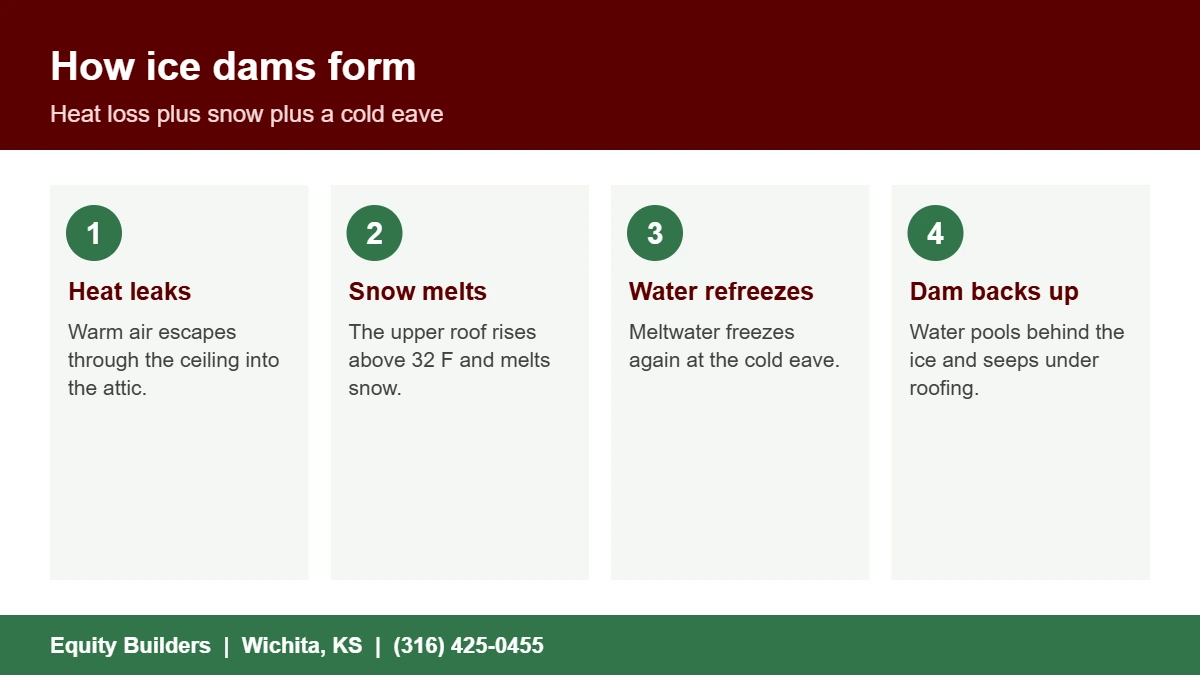
Three conditions are needed. The University of Minnesota Extension defines an ice dam as “a ridge of ice that forms at the edge of a roof” and keeps melting snow from draining off. It needs snow on the roof, upper roof areas above 32 F, and lower areas below freezing.
Meltwater runs down, refreezes at the cold edge and backs up behind the ridge. From there it can seep under the roof covering and reach the attic, walls and ceilings.
The InterNACHI page on ice dam hazards adds a point that surprises many owners: “Gutters do not cause ice dams to form, contrary to popular belief.” Gutters can concentrate ice in a vulnerable spot, though.
Do ice dams happen in Wichita and Kansas?
Yes, in some winters. Wichita’s winter normals sit on both sides of freezing. The National Weather Service lists a January normal high of 43.9 F and low of 22.5 F, and February at 48.9 F and 26.3 F. Daytime warmth melts snow, and nights refreeze it.
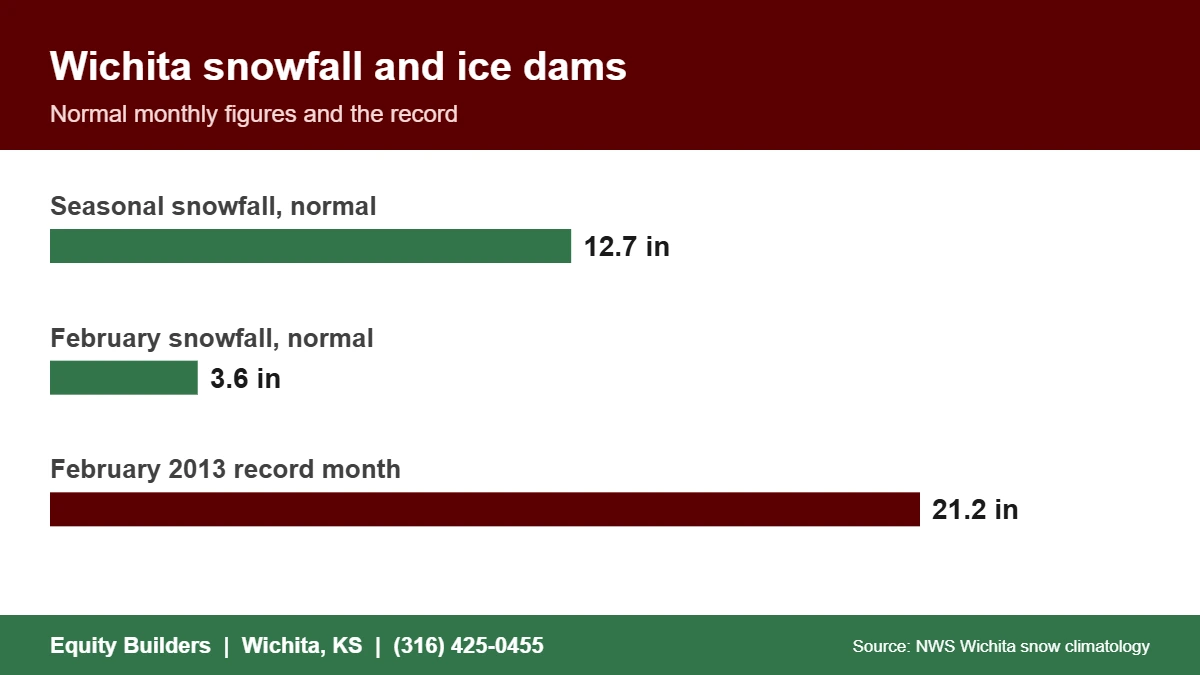
The NWS Wichita snow climatology page gives an average of 12.7 inches a season, with February the snowiest month at 3.6 inches. Measurable snow falls on about 9.2 days a season. The February 2013 total of 21.2 inches is the monthly record.
| Wichita winter measure | Normal or record |
|---|---|
| Seasonal snowfall, 1991 to 2020 | 12.7 inches |
| Snowiest month (February normal) | 3.6 inches |
| Days with measurable snow | About 9.2 per season |
| January normal high and low | 43.9 F and 22.5 F |
| Record monthly snowfall | 21.2 inches, February 2013 |
Older, complex roofs have more spots for ice dams. ServiceMaster of Wichita notes that College Hill and Riverside homes often have multiple valleys and dormers, and that older Midtown houses can lack insulation and ventilation.
What causes ice dams to start?
Heat from inside the house. The UMN Extension says the sun is a rare cause, and heat from the house is the main one. Its leading source is air leaking through ceiling openings such as light fixtures. In many homes, it says, this is “the major mode of heat transfer that leads to the formation of ice dams.”
Other sources include:
- Exhaust vents. Ducts that end just above the roof surface.
- Chimneys. Those used often, which warm the roof around them.
- Attic ductwork. Leaky or poorly insulated runs.
- Knee wall spaces. These can also add heat to the roof edge.
InterNACHI adds that sunlight alone can melt snow on a roof even when the air is well below freezing, so a dam can start on a cold, clear day.
How do you stop ice dams for good?
Work in this order, as the UMN Extension recommends:
- Air-seal the ceiling. Stop warm, moist air from moving from the house into the attic. Seal around wiring, plumbing, hatches and light fixtures.
- Add insulation. The Extension advises insulation with a high R-value per inch where space is tight. InterNACHI recommends at least 3 inches of air space between the top of the insulation and the roof sheathing.
- Keep the attic ventilated. Natural ventilation helps keep roof temperatures even and dries the attic.
The Extension also warns that mechanical attic ventilation is “not a recommended solution to ice dams in Minnesota.” See our guide to roof ventilation in Wichita for intake and exhaust planning.
Air sealing must come first, because added venting will not fix a ceiling that leaks warm air. A weatherization contractor can run a blower door test and use an infrared camera to find the leaks.
Does the building code require an ice barrier in Kansas?
Only where the jurisdiction designates it. Model code section R905.1.2 requires an ice barrier “in areas where there has been a history of ice forming along the eaves causing a backup of water,” as designated in Table R301.2(1). The details below are the 2015 wording as printed by Massachusetts. MABCD enforces the 2018 edition, so confirm the current text with them.
- What it is. Two layers of underlayment cemented together, or a self-adhering polymer-modified bitumen sheet.
- How far. From the lowest edge of the roof to not less than 24 inches inside the exterior wall line.
- Steep roofs. On slopes of 8 in 12 or more, also not less than 36 inches measured from the eave edge.
Whether Wichita’s local table designates ice barriers is not published in a source we could open. Ask MABCD at 316-660-1840 before you rely on either answer. The roof replacement permit process is the place to ask. Our roof replacement page lists what a full bid should include.
What should you avoid doing about ice dams?
Do not chip ice with a shovel or pick. InterNACHI says manual removal can damage the roof and injure you. It also says electric heat cables rarely work, take effort to install, use electricity and can make shingles brittle.
The UMN Extension allows a roof rake and push broom for snow, but warns they “may damage the roofing materials.” A channel cut through a dam is “only a temporary solution” and becomes ineffective within days. Anyone working on a roof in winter also risks a fall. Leave it to a professional who has the right fall protection.
Does home insurance cover ice dam damage?
Often the interior damage, not the dam removal. Farm Bureau Financial Services says most standard policies cover harm from ice dams caused by the weight of ice, snow or sleet. Interlock Roofing says insurers commonly treat removal of the dam as maintenance and exclude it, and that claims can be denied when damage comes from neglected upkeep or slow leaks.
Take dated photos and keep receipts. Coverage varies, so read your policy. Our guide to roof leak causes in Wichita helps separate an ice dam leak from other sources.
Ice dams questions from Wichita homeowners
Why do I get icicles but no ice dam?
Icicles mean some melting and refreezing, but not necessarily a dam. A dam is a ridge of ice at the eave that blocks drainage. Heavy icicles with ice in the valleys are a warning. Check the attic for frost, wet insulation or stains.
Can a new roof stop ice dams?
Not alone. A roof cannot fix heat loss from the ceiling. InterNACHI lists a metal roof as one way to shed snow and resist water, but it still recommends sealing attic leaks and adding insulation. Compare options in metal roofing in Wichita.
Do gutters cause ice dams?
No. InterNACHI says they do not, though they can concentrate ice. Keep them clear so meltwater can drain. See gutters in Wichita.
Get a roof and attic check in Wichita
Equity Builders is a Wichita roofing contractor founded in 1985, with crews certified by GAF, Owens Corning and CertainTeed and a lifetime workmanship warranty. If stains or leaks appear after a snow, we can inspect the roof edge and eave details. Call (316) 425-0455 or request a free estimate.
Sources
- University of Minnesota Extension, Dealing with and preventing ice dams
- InterNACHI, Ice Dam Hazards
- National Weather Service Wichita, climate normals and snow climatology
- Commonwealth of Massachusetts, FAQ on ice barrier requirements (IRC R905.1.2 text)
- Farm Bureau Financial Services, Does Homeowners Insurance Cover Water Damage?, August 25, 2025
- Interlock Roofing, Ice dam damage and insurance; ServiceMaster of Wichita, How to Prevent Ice Dams, January 2025
Last updated October 26, 2026. Code tables and policy wording vary. Confirm local requirements with MABCD and your insurer.