TPO vs EPDM roofing comes down to seams, surface color and the details around hail. TPO is a white, heat-welded thermoplastic. EPDM is a black or white synthetic rubber whose seams are made with tape or adhesive. Both are used on flat commercial roofs in Wichita, and neither wins on every building.
This guide compares the two membranes on chemistry, thickness, seams, heat reflection, hail, fire rating, cost and service life.
What is the difference between TPO and EPDM?
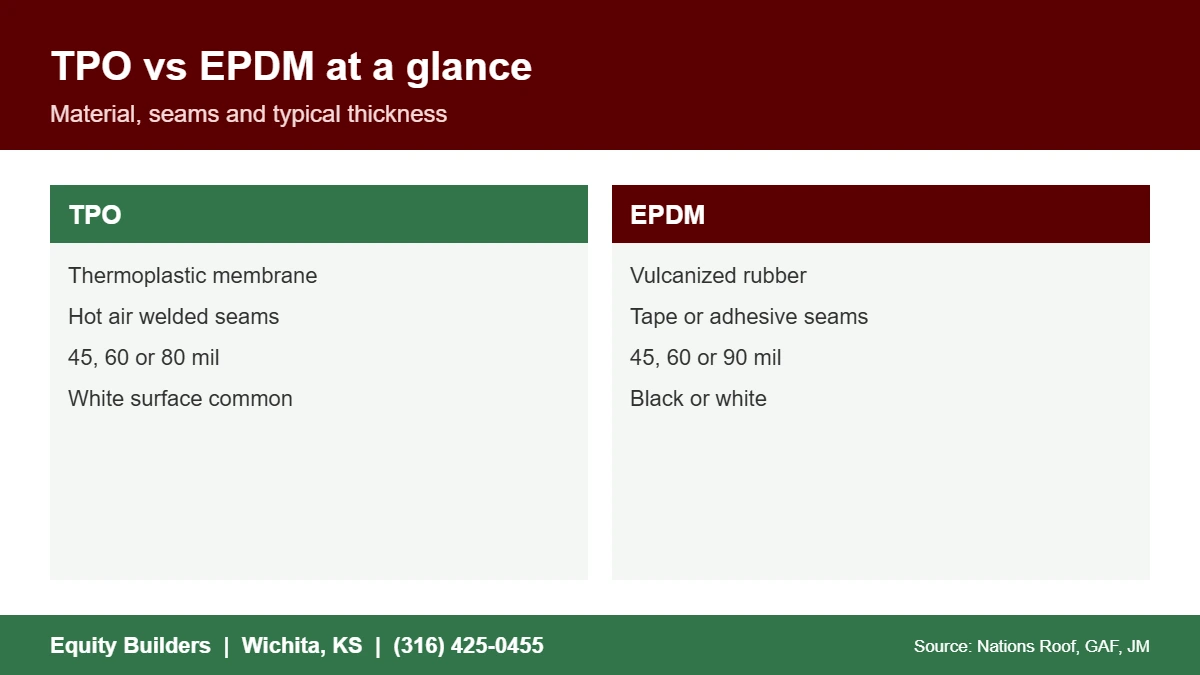
The difference is in the material. A February 2026 Nations Roof comparison describes TPO as a heat-weldable blend of polypropylene and ethylene-propylene rubber, reinforced with polyester. EPDM is made from ethylene, propylene and carbon black.
That chemistry drives the rest. TPO is a thermoplastic, so heat can fuse two sheets into one. EPDM is vulcanized rubber. Roofing Contractor magazine notes that EPDM becomes inert during vulcanization, so its seams cannot be solvent or heat welded.
| Feature | TPO | EPDM |
|---|---|---|
| Material | Thermoplastic, polyester reinforced | Vulcanized synthetic rubber |
| Common thickness | 45, 60 or 80 mil | 45, 60 or 90 mil |
| Seams | Hot air welded | Tape or adhesive, then lap sealant |
| Color | White, tan, gray | Black or white |
| InterNACHI life range | 7 to 20 years | 15 to 25 years |
Which is better for seams and leaks?
Welded seams are the main argument for TPO. Versico says a properly welded seam is one where the probe “will not penetrate into the lap area,” and welds should be probed at least 20 minutes after they cool.
EPDM seams depend on clean surfaces and cured adhesive. Roofing Contractor magazine states that seam failure “accounts for the majority of problems” with these systems. Talc, dust, trapped air and uncured adhesive are the usual causes.
When comparing TPO vs EPDM roofing bids, ask who installs the seams, how they are tested, and how penetrations and corners are detailed. See roof leak causes in Wichita.
How thick should a commercial membrane be?
Thicker sheets give more material above the reinforcement. GAF lists TPO at 45, 60 and 80 mil, and its data sheet gives system guarantees of up to 20 years for 45 mil, 25 years for 60 mil and 30 years for 80 mil on eligible systems. Johns Manville lists EPDM at 45, 60 and 90 mil in its selector guide.
In a TPO vs EPDM roofing comparison, thickness also changes the warranty offer, so price 60 mil and 80 mil options side by side with 45 mil.
Which handles Wichita heat better?
In a TPO vs EPDM roofing decision, surface color matters most. The NWS normal high for Wichita in July is 92.6 F. The Department of Energy says a conventional roof can exceed 150 F on a sunny summer afternoon, while a reflective roof can run more than 50 F cooler.
White TPO is built for that. GAF’s EverGuard TPO data sheet lists white at 0.81 initial and 0.75 three-year aged solar reflectance, with 0.90 emittance. Tan and gray run lower, at 0.65 and 0.59 initial. Check the Cool Roof Rating Council listing for any product you consider.
Black EPDM absorbs heat. A Firestone product manager argued in a 2009 article that dark roofs can cut heating needs in colder regions, and that white EPDM is available for cooling. That is a manufacturer’s view, and it is 17 years old. Wichita has both hot summers and a January normal low of 22.5 F, so a building energy model gives a better answer than a rule of thumb.
How does TPO vs EPDM roofing perform in Kansas hail?
Hail is the larger risk for flat roofs in this region. FM Approvals introduced its Very Severe Hail (VSH) rating in 2017. Versico explains that VSH uses a 2 inch ice ball fired at about 160 feet per second, roughly four times the impact energy of the older Severe Hail (SH) test with a 1.75 inch steel ball.
Both membranes can qualify, but only as full assemblies. Carlisle’s approved list includes 80 mil Sure-Weld TPO, 115 and 135 mil fleece-back TPO, and 115 mil and 145 mil fleece-back EPDM. Both Carlisle and Versico state that “common rooftop cover boards such as gypsum and HD polyiso are not approved.” Approved boards include plywood, OSB and high-compressive-strength products.
The cover board and fasteners matter as much as the sheet. In GAF testing published by Professional Roofing, 2 inch ice balls landing above metal fastener plates punctured TPO of any thickness. Ask for the FM approval listing of the whole assembly, not just the membrane. For damage after storms, see hail damage roof repair and storm damage roof repair in Wichita.
What are the fire ratings for TPO vs EPDM roofing?
Fire ratings belong to the assembly. GAF says its TPO is classified by UL under ANSI/UL 790, including Class A assemblies, and tells users to check UL Product iQ for the exact build-up. EPDM works the same way. Match the listing to the deck, insulation and cover board you are buying.
What does TPO vs EPDM roofing cost, and how long does each last?
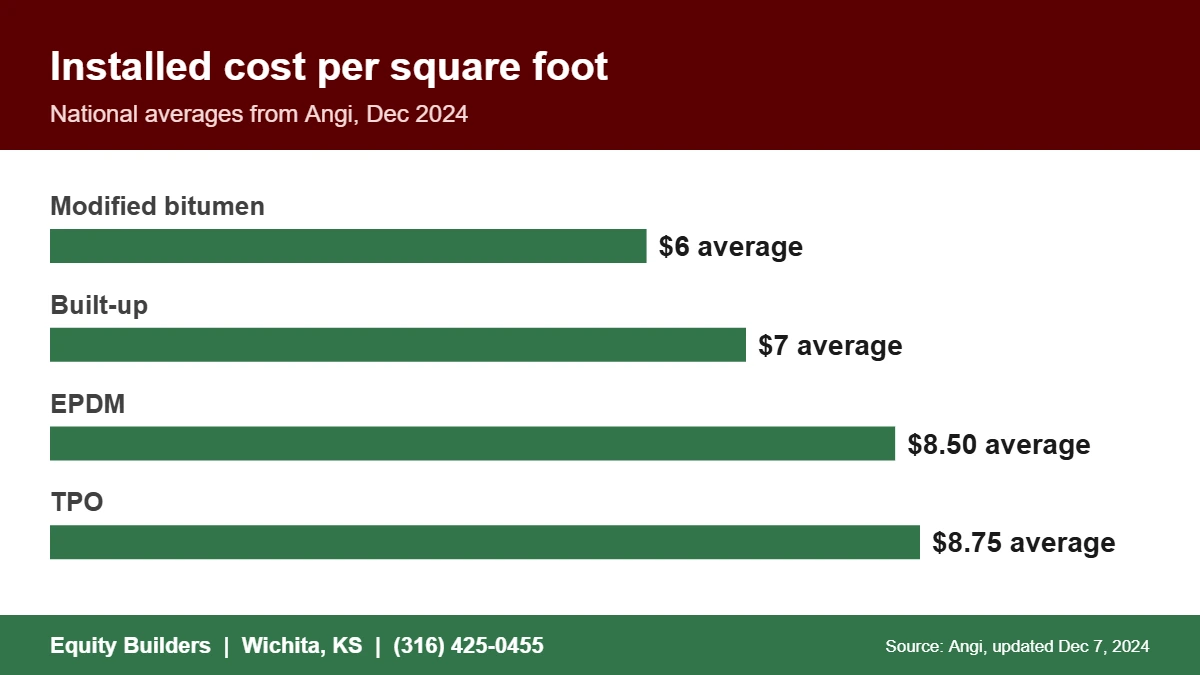
Installed prices are close. Angi’s flat roof page, last updated December 7, 2024, lists national averages of $8.75 per square foot for TPO ($4 to $14 range) and $8.50 for EPDM ($4 to $13). Those are national homeowner figures, not Wichita commercial bids. Insulation, tear-off and flashing change the total.
InterNACHI lists 15 to 25 years for EPDM and 7 to 20 for TPO, assuming regular maintenance. Manufacturers quote longer warranties than the field range.
Does a membrane replacement need a permit in Wichita?
A roofing permit applies. MABCD charges $0.05 per square foot of building footprint for a roofing permit, with a $50 minimum and a $1,500 maximum. Replacement under 400 square feet in a 12 month period is exempt. Contractors must schedule a final inspection. See Wichita roofing permit rules.
TPO vs EPDM questions from Wichita building owners
Is TPO or EPDM better for a flat roof?
Neither is better in every case. TPO suits owners who want a white surface and welded seams. EPDM suits owners who prefer rubber, want a black surface for winter heat gain, or have an installer with a long EPDM record. Choose the installer and detailing first.
Which lasts longer, TPO or EPDM?
InterNACHI lists EPDM at 15 to 25 years and TPO at 7 to 20, assuming regular maintenance. Ask for the exact product, thickness and warranty terms in writing.
Can you put TPO over EPDM?
Sometimes. FacilitiesNet reports that a recover is economical if less than 25% of the roof is damp, and that code requires wet areas to be removed. A moisture survey shows how much of the old roof is dry.
What thickness of TPO is best?
GAF ties its guarantees to thickness: up to 20, 25 and 30 years for 45, 60 and 80 mil. For hail, the TPO systems on Carlisle’s and Versico’s VSH lists use 80 mil or thicker membranes over approved cover boards.
Get a commercial roofing bid in Wichita
Equity Builders is a Wichita general contractor founded in 1985 that does residential and commercial roofing. Crews are certified by GAF, Owens Corning, CertainTeed, Malarkey, TAMKO and DaVinci, and no payment is due until the job is done. Ask for a side by side TPO vs EPDM roofing bid. Read about commercial roofing in Wichita and roof repair, then call (316) 425-0455 or request a free estimate.
Sources
- Nations Roof, TPO vs EPDM Roofing, February 9, 2026
- Roofing Contractor, Technical Details: Proper Installation and Repair of EPDM Seams
- Versico, Seam Probing (January 2020) and Understanding Very Severe Hail Ratings Parts 1 and 2 (September 2020)
- Carlisle SynTec, Understanding Very Severe Hail Ratings Part 2 (September 2020)
- GAF, EverGuard TPO Smooth 80, 60, 45 mil Data Sheet
- Johns Manville, EPDM Selector Guide
- Professional Roofing (NRCA), A Lasting Impression, June 2016
- U.S. Department of Energy, Cool Roofs
- Building Enclosure, EPDM Roofing Systems: A Strong, Energy-Efficient Option, October 7, 2009
- InterNACHI, Standard Estimated Life Expectancy Chart
- Angi, Flat Roof Replacement Cost, updated December 7, 2024
- FacilitiesNet, Visual Roof Exam, Moisture Survey Can Help Spot Zombie Roofs, 2013
- MABCD permits page and National Weather Service Wichita climate normals
Last updated October 24, 2026. Product approvals, prices and codes change. Confirm current listings with the manufacturer and FM Approvals.