An Assignment of Benefits (AOB) roofing agreement is a legal contract where a homeowner transfers insurance claim rights to a contractor, allowing that contractor to manage claims and collect payments directly from the insurer. For Wichita homeowners and property managers, understanding AOB roofing is more urgent than ever in 2026. Kansas Senate Bill 55 now prohibits residential AOB agreements, making them null and void under state law. Knowing what you are signing, what the law says, and how to protect your claim rights is the difference between a smooth roof repair and a costly legal dispute.
What is AOB roofing and how does it work?
AOB roofing, short for Assignment of Benefits roofing, is defined as a legal transfer of a homeowner’s insurance claim rights to a roofing contractor or third party. Once signed, the contractor steps into the homeowner’s position with the insurer. The contractor then files and manages claims directly, negotiates payment, and receives the insurance payout without the homeowner’s ongoing involvement.
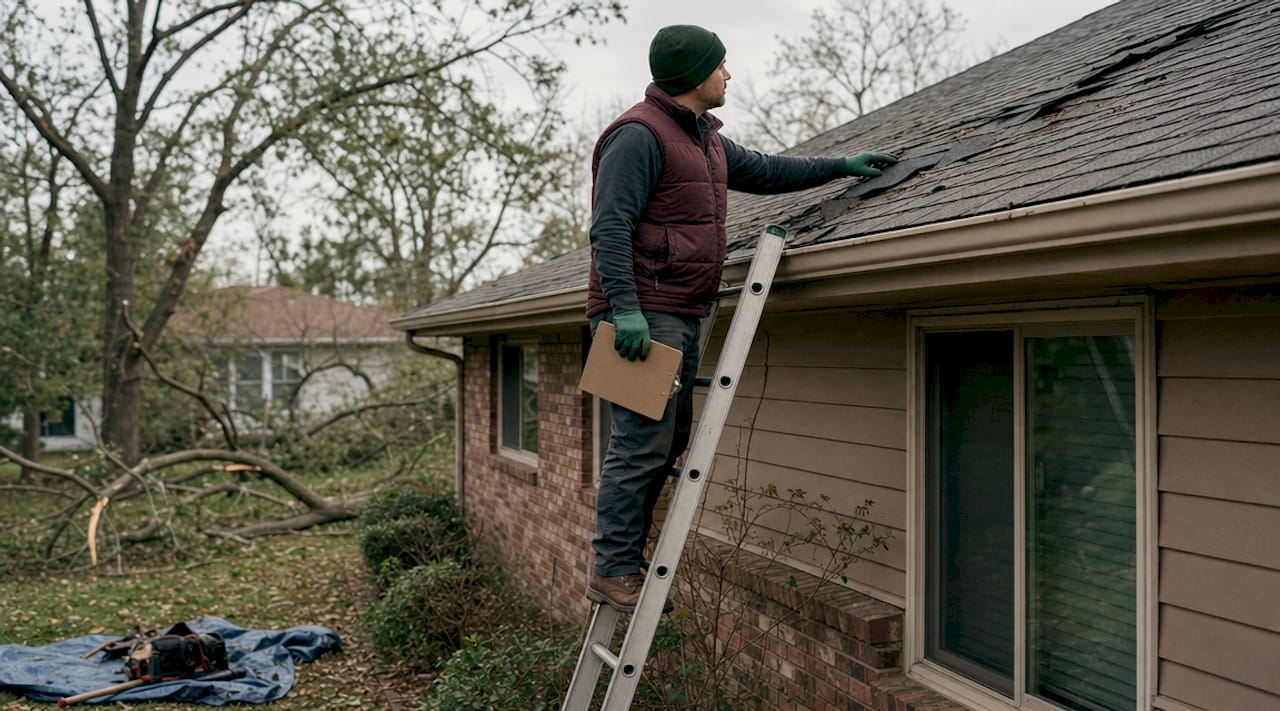
This arrangement is common in states where AOB is legal, particularly after storm damage events. A contractor arrives after a hail storm, inspects the roof, and presents paperwork that transfers claim authority to them. The appeal is convenience. The homeowner does not have to deal with the insurer directly. However, that convenience comes with a significant trade-off: you give up control over how your claim is handled, what repairs are approved, and how disputes are resolved.
For Wichita homeowners, the AOB roofing process is now largely off the table for residential claims. Kansas law has stepped in to preserve homeowner rights. Understanding why that matters starts with the legislation itself.
How does Kansas Senate Bill 55 affect AOB roofing agreements?
Kansas Senate Bill 55, enacted in 2026, is the most significant change to roofing and insurance law in the state in recent memory. The law prohibits soliciting or accepting assignment of post-loss insurance benefits for residential property claims. Any AOB agreement signed for a residential roofing claim is now null and void under Kansas law.
Here is what SB 55 specifically does:
- Amends K.S.A. 40-2404 to classify AOB agreements for residential post-loss benefits as against public policy.
- Treats violations as unfair or deceptive practices, giving the Kansas Insurance Commissioner authority to act against contractors who solicit or accept AOBs.
- Renders signed AOB documents unenforceable, meaning a contractor cannot use an AOB to collect insurance payments or manage your claim legally.
- Targets the solicitation itself, not just the signing. A contractor who even asks you to sign an AOB for a residential roofing claim is in violation of Kansas law.
The law’s intent is clear. Kansas legislators recognized that AOB agreements were being used to strip homeowners of claim control, often through high-pressure tactics following severe weather. The consumer-protection objective of SB 55 is to keep the homeowner in the driver’s seat throughout the insurance claim process.
Pro Tip: If a contractor presents you with any document after storm damage and asks you to sign immediately, stop. Ask specifically whether the document transfers any insurance claim rights. Under SB 55, any such transfer for a residential claim is illegal in Kansas.
How AOB roofing works nationally vs. the legal situation in Kansas
Outside of Kansas, AOB roofing agreements are legal in many states and widely used by contractors. Understanding how they function nationally helps clarify why Kansas chose to restrict them.
In states where AOB is permitted, the standard process works like this:
- A homeowner signs an AOB document after storm or hail damage.
- The contractor submits the insurance claim on the homeowner’s behalf.
- The insurer pays the contractor directly for approved repairs.
- The homeowner receives the completed roof work without managing claim paperwork.
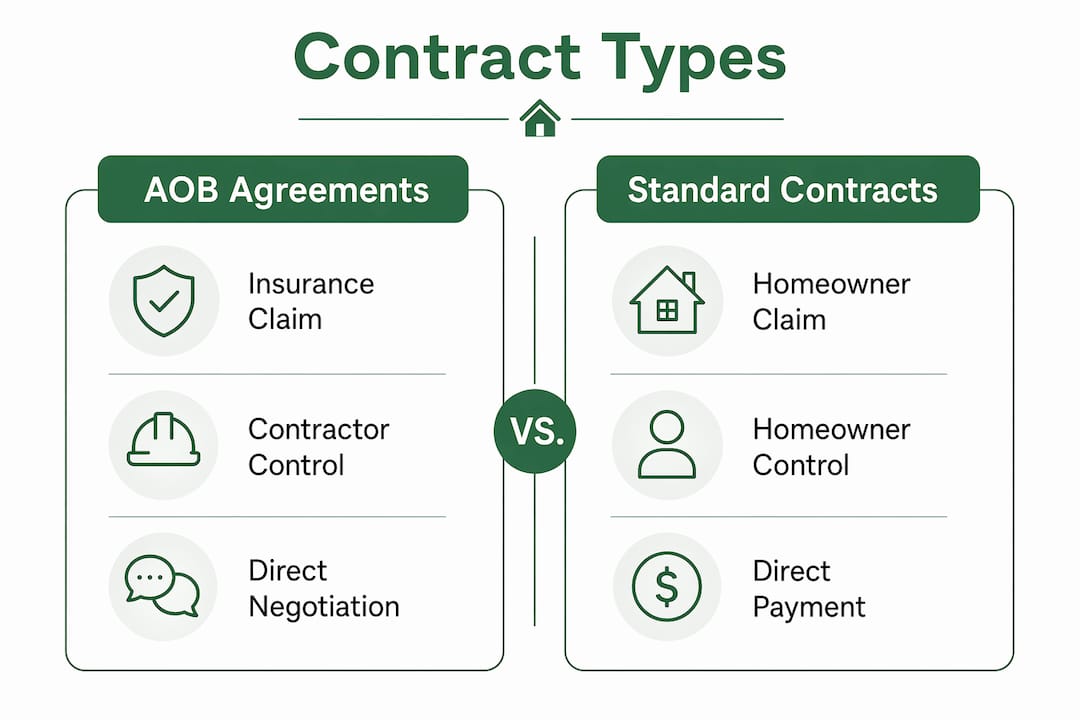
The benefits for contractors are direct negotiation power with insurers and control over claim timelines and payment. For homeowners in those states, the appeal is reduced administrative burden. However, the risks are real. When a dispute arises between the contractor and the insurer, the homeowner is sidelined. Underpayments, denied claims, and drawn-out appraisal processes become the contractor’s problem legally, but the homeowner’s problem practically since it is their roof that remains unrepaired.
| Feature | AOB Agreement (National) | Standard Contract (Kansas) |
|---|---|---|
| Who files the claim | Contractor | Homeowner |
| Who negotiates with insurer | Contractor | Homeowner or public adjuster |
| Who receives payment | Contractor directly | Homeowner, then pays contractor |
| Homeowner control | Minimal | Full |
| Legal in Kansas (residential) | No, prohibited by SB 55 | Yes |
Kansas’s approach reflects a growing national trend of states restricting AOB after widespread abuse. Florida, for example, enacted similar reforms after years of contractor fraud tied to AOB agreements. Kansas SB 55 puts Wichita homeowners in a protected position that residents in many other states do not have. Learning about hail damage to roofs in Kansas is the first step before any contractor conversation begins.
What is the difference between an AOB and a standard roofing repair contract?
This is where many Wichita homeowners get confused, and where some contractors exploit that confusion. Not every document a contractor presents is a full AOB. The legal distinction matters enormously.
A true AOB transfers your insurance claim rights entirely to the contractor. They become the claimant. They control the claim.
A standard repair authorization or direction to pay only allows the contractor to perform work and receive payment once the claim is settled. It does not transfer claim rights. Courts have confirmed this distinction. One ruling found that a contract granting negotiating authority but not full claim rights does not constitute a valid assignment.
The problem is that contract language is not always clear. Some documents use phrases like “authorize repairs,” “direction to pay,” or “limited power of attorney” in ways that blur the line. Courts look at the exact wording to determine whether a true assignment occurred. As a Wichita homeowner, you cannot rely on a contractor’s verbal explanation of what you are signing.
Watch for these warning signs in any roofing document:
- Language that says you “assign,” “transfer,” or “convey” your insurance rights or benefits.
- Clauses giving the contractor authority to “settle,” “negotiate,” or “resolve” your insurance claim.
- Any reference to the contractor acting “on your behalf” with your insurer without your direct involvement.
- Broad power of attorney language tied to your insurance policy.
Pro Tip: Before signing any roofing document, ask the contractor to point to the specific clause that authorizes their work and payment. If they cannot explain it clearly, or if the document contains any of the warning language above, do not sign. Have your insurance agent or an attorney review it first.
A legitimate contractor working in Wichita will use a straightforward work authorization form that describes the scope of repairs, pricing, and payment terms. That is all you need to get your roof fixed legally and safely.
How Wichita homeowners can protect themselves from AOB-related risks
Wichita sits in a region that sees significant hail and wind events every year. After a major storm, contractors arrive quickly, sometimes from out of state, and the pressure to sign paperwork fast is real. The Kansas Attorney General has warned homeowners specifically about door-to-door contractor tactics following severe weather, noting that unregistered contractors exploit the timing and vulnerability of storm-affected homeowners.
Follow these steps to protect yourself:
- Verify contractor registration. Check that any contractor is registered with the Kansas Attorney General’s office before allowing them on your property. Unregistered contractors have no accountability under Kansas law.
- Contact your insurance agent first. Before any contractor begins work or presents paperwork, call your insurance agent. They will guide you through the proper claims process and flag any documents that look like AOB agreements.
- Document your roof’s condition. Take photos and video of all visible damage before any contractor touches your roof. This protects you if a dispute arises about what damage existed before repairs began.
- Do not sign at the door. The Kansas AG’s office is direct on this point. Avoid signing documents presented by contractors at your door, especially immediately after a storm.
- Route all insurance communications through yourself. Do not give a contractor permission to contact your insurer directly unless your agent has reviewed and approved the arrangement.
- Know your cancellation rights. Kansas law provides a right to cancel certain contracts signed at your home within a specified period. Ask your agent or attorney about this protection if you have already signed something you are unsure about.
Property managers overseeing multiple Wichita properties face heightened risk because they may be managing claims across several buildings simultaneously. Maintaining detailed roof condition records and controlling all insurance communications centrally is the most reliable way to prevent unauthorized claim handling. Reviewing common roofing problems in Kansas homes before storm season helps you document baseline conditions accurately.
What should you do if a contractor asks you to sign an AOB document?
If a contractor presents you with what appears to be an AOB document in Wichita, take these steps in order:
- Stop and ask questions. Request a plain-language explanation of every clause in the document. Ask directly: “Does this transfer my insurance claim rights to you?” A legitimate contractor will answer clearly.
- Do not sign under pressure. Walk away from any contractor who insists you must sign immediately or risk losing your spot in their schedule. That is a pressure tactic, not a business practice.
- Verify their registration. Look up the contractor’s registration with the Kansas Attorney General before any further conversation. Unregistered contractors are a red flag regardless of what documents they present.
- Call your insurance agent. Share the document with your agent before signing anything. They can confirm whether the language constitutes an AOB and advise you on next steps.
- Know the law is on your side. Under SB 55, any AOB agreement for a residential roofing claim in Kansas is null and void. You cannot be legally bound by one even if you signed it, though avoiding the situation entirely is always preferable.
- Ask for a standard work authorization instead. A reputable contractor will have no problem replacing an AOB document with a straightforward repair contract that describes the work, cost, and payment terms without transferring your claim rights.
Pro Tip: Keep a photo of any document a contractor asks you to sign, even if you refuse to sign it. If the contractor is later found to be operating illegally, that documentation supports any complaint you file with the Kansas Insurance Commissioner or Attorney General.
Knowing how to file a roof insurance claim correctly in Wichita puts you in the strongest possible position before any contractor conversation begins.
Key takeaways
AOB roofing agreements are prohibited for residential claims in Kansas under Senate Bill 55, making homeowner knowledge of this law the single most effective protection against contractor fraud in Wichita.
| Point | Details |
|---|---|
| AOB definition | An AOB transfers insurance claim rights from a homeowner to a contractor, removing homeowner control. |
| Kansas SB 55 | The 2026 law renders residential AOB agreements null and void, treating them as deceptive practice. |
| AOB vs. repair contract | A standard repair authorization does not transfer claim rights; exact contract wording determines legal effect. |
| Contractor verification | Always check registration with the Kansas Attorney General before signing any roofing document. |
| Homeowner protection steps | Document damage, contact your insurer first, and never sign paperwork presented at the door under pressure. |
Why AOB knowledge matters more than most Wichita homeowners realize
Having worked alongside Wichita homeowners through storm seasons and insurance claims, I have seen the same scenario repeat itself. A hailstorm hits. Contractors are knocking on doors within 48 hours. A homeowner, relieved that someone is taking charge, signs a stack of paperwork without reading it. Weeks later, they discover the contractor has been negotiating with their insurer without their knowledge, and the settlement does not cover the full scope of repairs.
The misconception I encounter most often is that signing an AOB is simply a convenience measure, like giving someone power of attorney to pick up a package. It is not. It is a legal transfer of your rights as a policyholder. In states where AOB is legal, homeowners have lost the ability to contest claim decisions, dispute repair quality, or even choose a different contractor once the assignment is signed.
Kansas SB 55 closes that door for residential claims, and that is genuinely good news for Wichita homeowners. But the law only protects you if you know it exists. Contractors from out of state may not know Kansas law, or may not care. Your best defense is refusing to sign anything you have not reviewed with your insurance agent, and working only with registered, reputable local contractors who understand and comply with Kansas regulations. Choosing a contractor wisely is not a secondary concern. It is the foundation of a safe, successful roofing claim.
— Virtual
Work with a trusted Wichita roofing team that follows Kansas law
Roofwichita, operated by Equity Builders Roofing, provides residential and commercial roofing services throughout Wichita and surrounding communities, with full compliance with Kansas insurance laws including Senate Bill 55. Every homeowner deserves a contractor who handles paperwork honestly and keeps you in control of your claim.
Whether you need a roof inspection after storm damage or a full roof installation in Wichita, Roofwichita connects you with experienced, registered professionals who will never ask you to sign an AOB agreement. Contact Roofwichita today to get a free inspection and honest guidance on your roofing insurance claim, with no pressure and no confusing paperwork.
FAQ
What does AOB mean in roofing?
AOB stands for Assignment of Benefits. In roofing, it is a legal agreement where a homeowner transfers insurance claim rights to a contractor, allowing the contractor to file and manage the claim directly with the insurer.
Is AOB roofing legal in Kansas?
No. Kansas Senate Bill 55, enacted in 2026, prohibits AOB agreements for residential property insurance claims. Any such agreement is null and void under Kansas law.
What is the difference between an AOB and a repair authorization?
A repair authorization allows a contractor to perform work and receive payment but does not transfer your insurance claim rights. A true AOB transfers those rights entirely. Courts determine which applies based on exact contract language.
What should I do if a contractor pressures me to sign an AOB in Wichita?
Refuse to sign at the door, verify the contractor’s registration with the Kansas Attorney General, and contact your insurance agent before proceeding. The Kansas AG has warned homeowners specifically about high-pressure post-storm tactics.
Can I still get my roof repaired quickly without signing an AOB?
Yes. A reputable Wichita contractor will use a standard work authorization form that describes repairs and payment without transferring your claim rights. You retain full control of your insurance claim throughout the process.
Recommended
- Top Roofing Questions Homeowners Ask in Wichita | Expert Answers
- #1 Quality Roof Installation in Wichita, Kansas
- Annual Roof Inspections: Why Wichita Homeowners Need Them
- Best Roofing Material for Wichita Homes | Expert Guide 2025